History o' Phoeart
  • Home

Nature

  • Overview
  • Landscape or Seascape in 2D
  • Animals in 2D or 3D
  • The Elements (Fire, Water, Wind or Earth) in 2D or 3D
  • The Relationship between Man/Woman and Nature in 2D or 3D

Identity

  • Overview
  • The Divine in 2D or 3D Works
  • Portraits in 2D Works
  • Portraits in 3D Works
  • Gender Identity in 2D or 3D Works

Renaissance

  • Overview
  • Religious Painting
  • Religious Sculpture
  • Mythological in 2D or 3D
  • Portraits in 2D or 3D

Baroque

  • Overview
  • Religious Painting
  • Religious Sculpture
  • Mythological Painting
  • Mythological Sculpture

About

A comprehensive study resource for Pearson Edexcel History of Art A-Level.

NatureIdentityRenaissanceBaroque

History o' Phoeart - A-Level Study Resource

Pearson Edexcel Specification • Use ⌘K to search

  1. Home
  2. Paper 1
  3. Nature
  4. Landscape or Seascape in 2D
  5. Slavers Throwing Overboard the Dead and the Dying – Typhoon Coming On
Paper 1Nature
Nature
Landscape or Seascape in 2D
Pre-1850
Landscape with Marriage of Isaac and Rebecca

Landscape with Marriage of Isaac and Rebecca

Claude Lorrain

Seaport with Embarkation of Queen of Sheba

Seaport with Embarkation of Queen of Sheba

Claude Lorrain

Slavers Throwing Overboard the Dead and the Dying – Typhoon Coming On

Slavers Throwing Overboard the Dead and the Dying – Typhoon Coming On

JMW Turner

The Haywain

The Haywain

John Constable

Post-1850
Non-Western
Animals in 2D or 3D
The Elements (Fire, Water, Wind or Earth) in 2D or 3D
The Relationship between Man/Woman and Nature in 2D or 3D
Plants in 2D or 3D
Architecture

6 scopes • 24 artworks

Slavers Throwing Overboard the Dead and the Dying – Typhoon Coming On

JMW Turner, 1839
NaturePre-1850
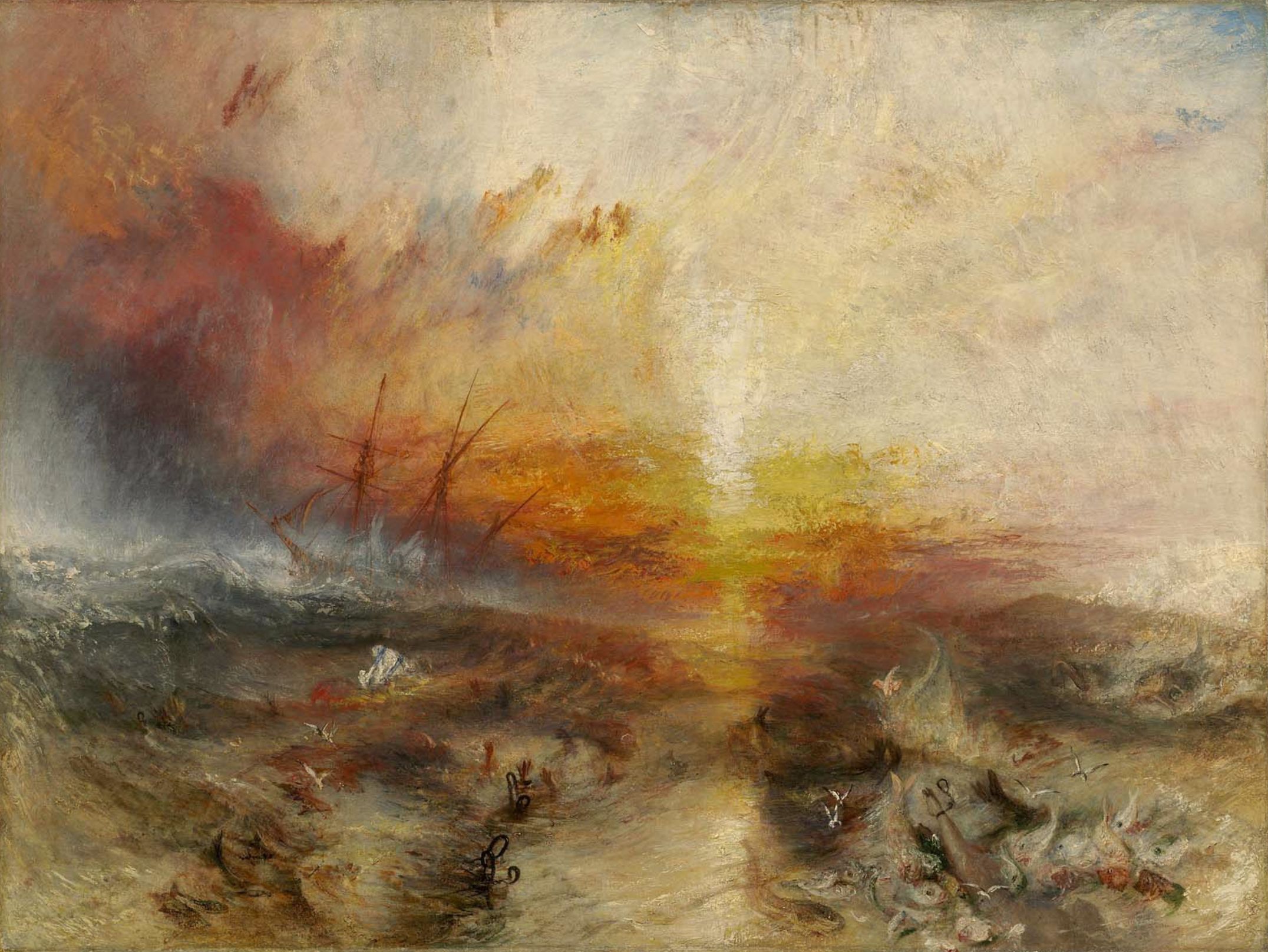
Slavers Throwing Overboard the Dead and the Dying – Typhoon Coming On by JMW Turner
J.M.W. Turner, Slavers Throwing Overboard the Dead and Dying—Typhoon Coming On, 1840, oil on canvas, Museum of Fine Arts, Boston

Overview

About This Work

Exhibited at the Royal Academy in 1840, Turner's Slave Ship (its shorter modern title) stands as one of the most morally powerful paintings in British art history. The full original title—Slavers Throwing Overboard the Dead and Dying—Typhoon Coming On—provides crucial context: it depicts the historical Zong massacre of 1781, when the British slave ship Zong threw 132 enslaved Africans overboard in cold, calm waters to secure insurance claims for "cargo lost at sea." Turner transforms this atrocity into a sublime seascape, where human evil is overwhelmed by nature's terrifying beauty. The painting measures approximately 90.8 x 138 cm (oil on canvas) and hangs in the Museum of Fine Arts, Boston. At exhibition, Turner paired the work with lines from his unpublished poem Fallacies of Hope, establishing the painting as not merely aesthetic spectacle but moral indictment. The work has proved endlessly interpretable: some see it as a condemnation of slavery; others argue its Romantic excess obscures rather than illuminates the historical horror.

Visual Analysis

Composition

Turner employs a radically unconventional compositional strategy that prioritizes atmospheric drama over narrative clarity. Elevated Perspective: The viewer's eye is positioned as though looking downward from the deck of another vessel, creating an unsettling distance from the drowning victims while simultaneously forcing confrontation with their fate. Asymmetrical Structure: Unlike the balanced classical compositions of Claude Lorrain, this painting is deliberately disordered. The slave ship recedes into the left distance—a dark, diminished spectre. The composition has no stable centre; instead, the setting sun creates a violent diagonal thrust across the entire canvas. The Sun as Fulcrum: The sun does not provide gentle illumination (as in Claude); instead, it dominates almost obscenely, burning orange-red, the primary visual anchor. All compositional lines—the horizon, the masts, even the churning water—are pulled toward this solar vortex. Foreground Horror: The immediately foreground is occupied by drowning figures, chains, and sea creatures. A shackled human leg (the most finely detailed element in the entire painting) protrudes from the water in the lower right, serving as the painting's most shocking motif and forcing the viewer's gaze upon a specific human extremity rather than the abstract sublime.

Colour & Light

This painting is fundamentally about colour as moral statement. The Apocalyptic Palette: Yellows, oranges, reds, and sickly greens dominate. The sea appears less like water and more like molten lava. Turner deliberately abandons naturalistic colour relationships; instead of blue water, he uses chocolate browns, greens, and maroons—colours that evoke disease, decay, and blood. The Blood-Red Sky: The sunset—traditionally a symbol of peace and beauty in landscape art—here becomes hellish. The red encroaches into the water, blurring the distinction between sky and ocean. This chromatic unity suggests that violence permeates the entire scene; there is no refuge. Absence of Clear Definition: Objects dissolve into colour fields. The ship is barely distinguishable from the stormy sky; human bodies fragment into indistinct shapes. This indistinctness is not laziness but intentional strategy: the viewer cannot clearly see the drowning figures, creating a sense of horror through obscuration rather than explicit depiction. Dramatic Contrast: The right side of the composition is luminous and almost tranquil (pale blues, whites); the left is turbulent and dark. This duality mirrors the duality of the scene itself: nature's beauty and nature's terror, divine judgment and human suffering.

Materials & Technique

Oil Paint and Impasto: Turner applied paint with extraordinary energy—rapid, frenzied brushstrokes that convey movement and chaos. The paint is sometimes thick (impasto), sometimes thin (glazed), creating a surface that mimics the violence of churning water. Finish and Process: The painting appears almost unfinished to contemporary eyes—details dissolve into abstraction. This was controversial in 1840; critics complained of "yellow chaos." Turner was deliberately embracing what would later be called "painterly abstraction," prioritising emotional and chromatic impact over descriptive clarity. Light Effects: Turner has created luminous yellows and whites by applying bright pigments over darker underpainting. The sun glows with an inner light that seems to emanate from within the canvas itself, a technical achievement that required careful layering of pigments. The Shackled Leg: In striking contrast to the painting's overall indistinctness, the leg and chains in the foreground are rendered with sharp definition and careful modeling. This creates a grotesque focal point—the most "finished" part of the painting depicts human bondage.

Historical Context

Context

The Zong Massacre (1781): The painting references a specific, documented atrocity. The ship Zong, captained by Luke Collingwood, departed Africa with enslaved Africans as cargo. Following navigational errors, the crew ran short of fresh water. Rather than endure the financial loss from slaves expected to die of disease, the crew and captain decided to throw sick and dying enslaved people overboard—an act insured under maritime law. Between 29 November and 2 December 1781, 132 African men, women, and children were murdered in this manner. The ship's owners sought insurance compensation; the case reached courts and became a rallying point for abolitionists. Turner's Knowledge: Turner learned of the Zong massacre through Thomas Clarkson's History and Abolition of the Slave Trade (1839 edition). The timing is significant: Turner painted Slave Ship in 1840, coinciding with heightened abolitionist campaigns and increased international pressure against the slave trade (notably, Britain had abolished the slave trade itself in 1807 and slavery in the colonies by 1833, but the transatlantic trade continued). Turner's Era: By 1840, Turner (1775–1851) was an elderly man, already famous and financially secure. The painting represents a late-career engagement with political and moral themes. It demonstrates that Romantic landscape painting was not merely aesthetic but could carry urgent ethical weight. The Poem: Turner's inclusion of lines from Fallacies of Hope—his unpublished, unfinished philosophical poem—suggests his intention to critique not only slavery but broader human presumption and moral failure. The "fallacies of hope" refer to humanity's false belief in progress and civilization.

Key Themes

Connection to Nature and The Sublime (War Against Humanity)

This painting collapses the boundary between "Nature" as theme and "War" as theme. The painting is fundamentally about the Sublime. Edmund Burke's Sublime: Burke (1757) theorised that we experience "sublime" emotion—a mixture of terror and pleasure—when confronting nature's overwhelming power. Turner's drowning figures are insignificant against the vast ocean and burning sky. The painting suggests that human evil (slavery) is ultimately negligible compared to nature's grandeur and justice. Divine Judgment: The approaching typhoon functions as divine retribution. The guilty ship—identifiable by its blood-red masts—heads toward darkness and storm. Nature itself becomes an agent of moral correction; the ocean that consumed the enslaved will also consume their murderers. The Inversion of Pastoral: Claude Lorrain's "Ideal Landscape" depicted harmonious coexistence between humans and nature. Turner inverts this: nature is hostile, indifferent, and violent. The sea is not a benevolent pathway (as in the Seaport with the Queen of Sheba) but a devouring monster, populated by grotesquely rendered sea creatures with gaping mouths. Human Insignificance: All figures—slave and enslaver alike—are dwarfed by atmospheric and aquatic forces. The painting poses a philosophical question: Does nature's supremacy diminish or amplify the moral horror of slavery? Is humanity's smallness before nature a comfort (all our crimes are ultimately trivial) or a condemnation (we are powerless, thus all more culpable)?

Exam Focus Points

Critical Perspectives

Ruskin's Defence: John Ruskin, Turner's great champion, wrote extensively about Slave Ship in Modern Painters (1843). He argued that Turner's abstract, colourful style was perfectly suited to its subject because colour—not narrative detail—could convey moral and emotional truth. Ruskin famously described the painting as a vision of "justice" and "wrath." This remains influential in defending Romantic aesthetics as a valid mode of moral expression. The Aesthetic-Political Paradox: Critics have long debated whether Turner's prioritization of colour and sublime sensation over explicit narrative undermines or enhances the work's abolitionist message. Does the painting's beauty seduce us into complicity? Or does the shock of recognising beauty alongside horror intensify our moral revulsion? This tension is central to A Level essays on "Art and Morality." Racial Representation: Modern scholars (e.g., K. D. Kriz) have critiqued Turner's depiction of enslaved Africans as fragmented, indistinct bodies—a visual practice with deep roots in Western racial ideology. While Turner appears sympathetic, his Romantic language of the sublime and the fragmentary body may inadvertently perpetuate dehumanization. The painting's power to move white viewers may rest partly on its refusal to show enslaved Africans as fully human, recognizable individuals. The Comparison to Claude: Examiners frequently set questions asking students to compare Turner's Slave Ship with Claude's seaports or landscapes. The contrast is stark: Claude's luminous, ordered, harmonious vision versus Turner's chaotic, violent, morally ambivalent vision. This pair exemplifies two fundamentally different artistic philosophies—Classicism vs. Romanticism—and their moral implications. Historical Accuracy vs. Artistic License: Turner invented the typhoon; the Zong massacre occurred in calm waters. This deliberate distortion raises questions about artistic responsibility. Does poetic licence serve truth or obscure it? Turner prioritised emotional and philosophical truth (nature's judgment) over factual truth (historical conditions). A Level responses should engage this tension substantively. Turner and Abolitionism: The painting has been read as a political intervention in abolitionist campaigns. Yet Turner's own views on slavery are unclear from documentary evidence. Some argue the painting is ambiguous—simultaneously condemning slavery and celebrating the Romantic sublime, potentially allowing viewers to enjoy the aesthetic without confronting the moral. This ambiguity is itself worth analysing.

On this page

OverviewVisual AnalysisHistorical ContextKey ThemesExam Focus Points