The Ambassadors
Hans Holbein, 1533
Overview
About This Work
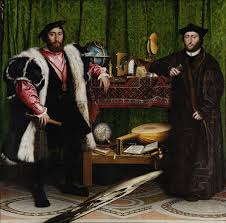
The Ambassadors (1533) is one of the most sophisticated and enigmatic paintings in Western art history. Painted by Hans Holbein the Younger (1497/8–1543), the work measures 207 x 209.5 cm (oil and tempera on oak panel) and is housed in the National Gallery, London. It depicts two young French diplomats: Jean de Dinteville (left), the French ambassador to the English court, and his close friend Georges de Selve (right), Bishop-elect of Lavaur. The men stand on either side of an elaborately laden shelving unit displaying scientific instruments (astrolabes, globes, sundials), musical instruments (a broken-stringed lute, flutes), and religious texts (a hymnal). The painting celebrates the intellectual sophistication and cultural refinement of the Renaissance while simultaneously confronting the viewer with profound philosophical and theological questions about mortality, salvation, and faith. Most famously, the painting contains a distorted anamorphic skull—a skull rendered in exaggerated perspective that only becomes visible when the painting is viewed from a specific oblique angle—functioning as a memento mori (reminder of death). The work was painted during one of the most politically and religiously charged moments in European history: Henry VIII's break with Rome and his marriage to Anne Boleyn, which threatened the established order of Christendom.