History o' Phoeart
  • Home

Nature

  • Overview
  • Landscape or Seascape in 2D
  • Animals in 2D or 3D
  • The Elements (Fire, Water, Wind or Earth) in 2D or 3D
  • The Relationship between Man/Woman and Nature in 2D or 3D

Identity

  • Overview
  • The Divine in 2D or 3D Works
  • Portraits in 2D Works
  • Portraits in 3D Works
  • Gender Identity in 2D or 3D Works

Renaissance

  • Overview
  • Religious Painting
  • Religious Sculpture
  • Mythological in 2D or 3D
  • Portraits in 2D or 3D

Baroque

  • Overview
  • Religious Painting
  • Religious Sculpture
  • Mythological Painting
  • Mythological Sculpture

About

A comprehensive study resource for Pearson Edexcel History of Art A-Level.

NatureIdentityRenaissanceBaroque

History o' Phoeart - A-Level Study Resource

Pearson Edexcel Specification • Use ⌘K to search

  1. Home
  2. Paper 1
  3. Identity
  4. Portraits in 2D Works
  5. Mr and Mrs Clark and Percy
Paper 1Identity
Identity
The Divine in 2D or 3D Works
Portraits in 2D Works
Pre-1850
Post-1850
Portrait of Lady Lavery as Kathleen Ni Houlihan

Portrait of Lady Lavery as Kathleen Ni Houlihan

Sir John Lavery

Chairman Mao en route to Anyuan

Chairman Mao en route to Anyuan

Liu Cunxia

Mr and Mrs Clark and Percy

Mr and Mrs Clark and Percy

David Hockney

Portraits in 3D Works
Gender Identity in 2D or 3D Works
Ethnic Identity in 2D or 3D Works
Identity in Architectural Works

6 scopes • 24 artworks

Mr and Mrs Clark and Percy

David Hockney, 1971
IdentityPost-1850
Mr and Mrs Clark and Percy by David Hockney
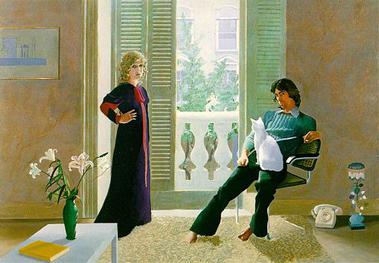
Mr and Mrs Clark and Percy, David Hockney, 1970–1971, acrylic on canvas, 213.4 × 304.8 cm, Tate Gallery, London

Overview

About This Work

Mr and Mrs Clark and Percy (1970–1971) is one of David Hockney's most celebrated and iconic paintings, measuring a monumental 213.4 x 304.8 cm (approximately life-size) in acrylic on canvas. It depicts the fashion designer Ossie Clark and textile designer Celia Birtwell in their Notting Hill Gate flat in London, shortly after their wedding in 1969. The painting is housed in the Tate Gallery, London, where it was donated in 1971 and has become one of the most beloved and visited works in the collection, appearing in Tate's prestigious 2005 "Greatest Painting in Britain" vote (the only living artist's work in the final ten). The painting represents Hockney's mature engagement with portraiture, Pop Art, and the exploration of contemporary domestic life. It exemplifies his distinctive synthesis of photographic realism with modernist abstraction, his unconventional perspective play, and his focus on the intimate emotional dynamics between two people. The work is famous not only for its technical virtuosity but also for its prophetic resonance: the couple's marriage would dissolve in 1974, and contemporary critics have noted how Hockney's spatial separation of the figures (divided by the window) and their psychological distance prefigures this dissolution.

Visual Analysis

Composition

The Divided Window: The most striking compositional feature is the large full-length casement window that vertically divides the canvas into two halves. The window creates both visual separation and unity—separating the couple spatially while simultaneously framing them within a unified domestic interior. Gender Reversal in Positioning: Ossie sits in a relaxed posture on a low, tubular chrome chair (a modernist design icon), while Celia stands upright with dignified presence. This reversal of conventional gender roles and traditional portraiture hierarchies suggests her power and authority. The seated position traditionally signals authority in portraiture; Hockney subverts this by associating passivity with the male figure. Gazes and Triangulation: Both figures gaze directly at the viewer, creating a "triangular" visual relationship where the viewer becomes the third point of the composition. The cat (Percy/Blanche), by contrast, looks away toward the window, ignoring the viewer and suggesting a differing consciousness or an indifference to human drama. The Triangulated Space: The room extends behind the figures with precise linear perspective. The floor tiles recede toward a back wall, and the window frames a balcony and sky beyond, creating multiple layers of spatial recession. Yet the figures remain relatively flat and frontal, creating a tension between volumetric space and planar flattening. Contre-jour (Backlighting): The figures are illuminated from behind by the brilliant light flooding through the window. This creates a subtle silhouetting effect and emphasizes the flatness of their forms. This lighting situation (which Hockney noted he chose because he "liked the light there") creates psychological distance and an almost ethereal quality.

Colour & Light

Vibrant Colour Against Minimalism: The painting employs a restrained palette (whites, greys, pale blues) punctuated by vivid acrylic colour. Celia's bright red dress is a shocking, attention-commanding accent that asserts her presence. Ossie's light blue jumper is softer and more recessive. These colours are not naturalistic but deliberately chosen for psychological and compositional effect. The White Lilies: A vase of white lilies sits on a table beside Celia. Lilies traditionally symbolize purity and chastity but also the Annunciation (the angel Gabriel's visit). At the time of the portrait, Celia was pregnant, so the lilies reference fertility and the imminent birth of their child. The White Cat: The cat's whiteness echoes the lilies, the paper-white walls, and the brilliant sky. Yet Hockney notes the cat was actually named Blanche but he preferred "Percy" for the title. This deliberate naming choice has generated considerable speculation: does "Percy" allude to sexual meanings (slang for penis)? Does it reference infidelity and betrayal (cats being emblematic of infidelity in Renaissance portraiture)? The Balcony and Sky: Beyond the window, a crisp white balcony and brilliant blue sky suggest the world outside the domestic interior. Yet this view is visually framed and contained, suggesting that the couple's world, despite its modernity and openness, is circumscribed.

Materials & Technique

Acrylic on Canvas: The work is painted in acrylic, a relatively new medium in the late 1960s that allowed for rapid working and vivid colour saturation. Acrylics dry quickly, enabling Hockney to work in multiple layers without waiting for oil paint to dry. Photographic Reference and Reworking: Hockney took extensive photographs of the couple in their flat (1969) and made numerous preparatory drawings. He then worked on the final canvas from spring 1970 to early 1971. He repainted Ossie's head approximately twelve times, struggling to capture the correct psychological expression and spatial placement. This laborious process contrasts with the apparent effortlessness of the finished work. Balance of Realism and Abstraction: While the overall composition reads as naturalistic portraiture, many surfaces are "abstracted" or flattened. The window panes are schematically simplified; certain areas of clothing become areas of flat colour. Hockney describes this as his closest approach to "naturalism," yet it remains fundamentally modernist in its spatial ambiguities and formal flattening.

Historical Context

Context

The Couple: Ossie Clark (1942–1996) was the most celebrated British fashion designer of the late 1960s and early 1970s, known for his innovative, sensual designs that defined "Swinging London." Celia Birtwell was a textile designer whose bold, distinctive patterns were integral to Clark's collections. They married in 1969. Hockney, who met Clark in Manchester in 1961 and had a long-term friendship/romantic relationship with him, was Clark's best man at the wedding. The Notting Hill Setting: Notting Hill in 1970 was a fashionable enclave of artists, designers, and bohemians. It represented the creative heart of London's counter-cultural scene. The couple's minimalist flat embodies the spare aesthetic of the era. Pop Art Context: Although by 1970–71 the Pop Art movement was no longer "new," Hockney remained committed to Pop's principles: incorporating contemporary subjects (his friends), employing vivid colour, and referencing mass media (photography). Yet unlike earlier Pop (Warhol), Hockney's Pop is intimate and personal, focused on his immediate social circle. Double Portraiture Series: This painting is part of a series of large double portraits Hockney created from 1968 onward, including Christopher Isherwood and Don Bachardy, Henry and Christopher, and others. These works explore the visual and psychological representation of couples—their intimacy, their tensions, their individuality within partnership.

Key Themes

Identities (Gender, Domesticity, Contemporary Life)

Gender Dynamics: The reversal of traditional gender hierarchies (woman standing, man seated) challenges conventional power structures. Yet Ossie's anxious, questioning gaze (he looks somewhat troubled or vulnerable) suggests psychological complexity. Celia's confident, direct gaze suggests strength. The painting captures a moment of equilibrium that, historically, would not endure. Modern Domesticity: The minimalist interior, the tubular chrome chair, the industrial window—all signal 1960s modernist domesticity. The couple are shown in their private domestic space, yet this space is presented with the formality and clarity of a museum display. The home is both intimate and distanced. Marriage as Psychological State: Hockney's stated aim was "to paint the relationship of these two people." Rather than showing romantic closeness, he depicts separation and psychological distance despite physical proximity. The window dividing them is not merely a spatial device but an emblem of their separate selfhoods.

Exam Focus Points

Critical Perspectives

Photographic vs. Painted: Hockney uses photography as a preparatory tool, yet the final painting is not photorealistic. There is a deliberate gap between the photographic reference and the painted realization. This raises questions: What does painting add that photography cannot? How does the artist's hand and subjectivity intervene in the image? Realism vs. Abstraction: The work walks a difficult line between these poles. It looks realistic, yet its spatial logic is fundamentally cubist and modernist. The perspective is not consistent; surfaces flatten and abstain; colour is employed symbolically. Students should discuss how Hockney achieves a "new" realism by synthesizing modernist abstraction with figurative representation. Prophecy and Hindsight: The painting's later history (the couple's divorce three years after its completion) has invested it with tragic irony. Hockney has remarked that the painting "probably caused" the divorce—as if the visual documentation of their separation externalized tensions already present. This reflects on the power of portraiture: does representation capture or create reality? The "Positive Homosexuality" in Hockney: Hockney was openly gay at a time (1970s) when homosexuality remained illegal in many places. His painting of Ossie and Celia, despite being ostensibly a heterosexual couple's portrait, is also a portrait of intimate friendship. The knowledge of Hockney's close friendship/former romance with Ossie adds layers of meaning to the painting's representation of coupledom. Comparison to Gainsborough's Mr and Mrs Andrews and The Byam Family: All three works depict couples in landscapes or domestic interiors. Yet the power dynamics differ. In Gainsborough, the man points into the landscape with possessive authority; in Hockney, both figures gaze at the viewer with equal frontal presence. Hockney's modernism has fundamentally altered the politics of portraiture.

On this page

OverviewVisual AnalysisHistorical ContextKey ThemesExam Focus Points