History o' Phoeart
  • Home

Nature

  • Overview
  • Landscape or Seascape in 2D
  • Animals in 2D or 3D
  • The Elements (Fire, Water, Wind or Earth) in 2D or 3D
  • The Relationship between Man/Woman and Nature in 2D or 3D

Identity

  • Overview
  • The Divine in 2D or 3D Works
  • Portraits in 2D Works
  • Portraits in 3D Works
  • Gender Identity in 2D or 3D Works

Renaissance

  • Overview
  • Religious Painting
  • Religious Sculpture
  • Mythological in 2D or 3D
  • Portraits in 2D or 3D

Baroque

  • Overview
  • Religious Painting
  • Religious Sculpture
  • Mythological Painting
  • Mythological Sculpture

About

A comprehensive study resource for Pearson Edexcel History of Art A-Level.

NatureIdentityRenaissanceBaroque

History o' Phoeart - A-Level Study Resource

Pearson Edexcel Specification • Use ⌘K to search

  1. Home
  2. Paper 1
  3. Identity
  4. Portraits in 2D Works
  5. Portrait of Lady Lavery as Kathleen Ni Houlihan
Paper 1Identity
Identity
The Divine in 2D or 3D Works
Portraits in 2D Works
Pre-1850
Post-1850
Portrait of Lady Lavery as Kathleen Ni Houlihan

Portrait of Lady Lavery as Kathleen Ni Houlihan

Sir John Lavery

Chairman Mao en route to Anyuan

Chairman Mao en route to Anyuan

Liu Cunxia

Mr and Mrs Clark and Percy

Mr and Mrs Clark and Percy

David Hockney

Portraits in 3D Works
Gender Identity in 2D or 3D Works
Ethnic Identity in 2D or 3D Works
Identity in Architectural Works

6 scopes • 24 artworks

Portrait of Lady Lavery as Kathleen Ni Houlihan

Sir John Lavery, 1927
IdentityPost-1850
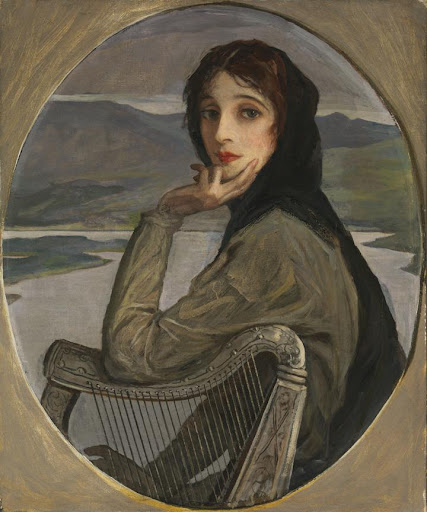
Portrait of Lady Lavery as Kathleen Ni Houlihan by Sir John Lavery
Portrait of Lady Lavery as Kathleen Ni Houlihan, Sir John Lavery, 1927, oil on canvas, 76 × 63.5 cm, Private Collection (image used on Irish banknotes 1928–1975)

Overview

About This Work

This iconic portrait depicts Hazel Lavery, the glamorous American-born wife of Irish artist Sir John Lavery, in the guise of Kathleen Ni Houlihan—the legendary personification of Ireland. Commissioned for use on Irish Free State banknotes, the image became one of the most widely reproduced artworks in Irish history, appearing on currency from 1928 until 1975. Hazel Lavery was a prominent society figure and political hostess who played a controversial behind-the-scenes role in Anglo-Irish negotiations during the Irish War of Independence. Her transformation into the symbol of the new Irish nation represented a remarkable fusion of personal glamour, political symbolism, and artistic prestige. The painting shows Lady Lavery in a contemplative pose, leaning on an Irish harp against a backdrop of the Lakes of Killarney. Her dark hair and pale complexion evoke traditional representations of Ireland as a beautiful, melancholic woman, while her fashionable appearance anchors the image in contemporary sophistication.

Visual Analysis

Composition

The composition employs an oval format within a rectangular frame, creating an intimate cameo effect reminiscent of Renaissance portrait miniatures and Victorian lockets. This format elevates the subject to an almost sacred or commemorative status—appropriate for an image destined for national currency. Lady Lavery is positioned in three-quarter view, her body angled toward the left while her face turns toward the viewer with a direct, contemplative gaze. Her left hand supports her chin in a pose suggesting thoughtfulness and gentle melancholy—traditional attributes of allegorical representations of Ireland. The Irish harp dominates the lower portion of the composition, its curved form echoing the oval frame and Lady Lavery's elegant posture. As Ireland's official symbol, the harp transforms what might be a conventional society portrait into a national allegory. The landscape background—depicting the Lakes of Killarney in County Kerry—extends the symbolic programme, representing Ireland's natural beauty while the water and mountains create atmospheric depth that prevents the composition from feeling static or flat.

Colour & Light

Lavery employs a restrained, sophisticated palette dominated by silvery greys, muted greens, and soft blues that create an atmosphere of refined melancholy. This tonal approach reflects both the influence of Whistler's aesthetic harmonies and the misty quality of Irish light. The figure is illuminated by soft, diffused light from the upper left, modeling Lady Lavery's features with subtle gradations that emphasise her pale complexion and dark hair. Her olive-green dress merges tonally with the landscape, suggesting unity between the personified nation and its land. The only warm notes appear in her lips and the subtle flush of her cheeks, providing focal points that draw the eye to her face. The harp's silvery-grey tones integrate it seamlessly with the overall colour scheme while its darker carved details provide necessary contrast. The atmospheric perspective of the landscape background—with its hazy blues and soft greens—creates a sense of infinite space and romantic distance appropriate to the mythic dimensions of the subject.

Materials & Technique

Lavery's technique demonstrates the fluid, confident brushwork of an artist at the height of his powers. His approach combines the bravura handling associated with Sargent and the Glasgow School with a more delicate touch suited to the intimate scale and commemorative purpose of this work. The face is painted with careful attention to subtle tonal transitions, achieving a porcelain-like smoothness that enhances the subject's beauty while maintaining convincing three-dimensionality. The hair is rendered with looser, more expressive strokes that suggest its dark mass without laborious detail. The dress and background are handled with greater freedom, allowing the weave of the canvas to show through in places and creating a sense of atmospheric softness. The harp is painted with enough precision to be recognisable while avoiding the hard edges that might disrupt the overall tonal harmony. This combination of careful finish in key areas with broader handling elsewhere reflects Lavery's training in both academic traditions and modern approaches to portraiture.

Historical Context

Context

The commission emerged from a specific historical moment: the establishment of the Irish Free State in 1922 and the need to create visual symbols for the new nation. The Currency Commission chose Lavery, Ireland's most internationally celebrated living artist, to design the images for the new banknotes. Lavery's choice to depict his wife as Kathleen Ni Houlihan was both personal and political. Hazel Lavery had been intimately involved in the Anglo-Irish negotiations, hosting secret meetings at their London home and allegedly conducting a romantic relationship with Michael Collins. Her transformation into the symbol of Ireland thus carried complex undertones of personal ambition, political intrigue, and artistic self-promotion. The image participated in a long tradition of representing Ireland as a woman—from the medieval sovereignty goddesses through the aisling poetry of the 18th century to the political allegories of the 19th century. Kathleen Ni Houlihan specifically referenced W.B. Yeats and Lady Gregory's 1902 play, in which Ireland appears as an old woman transformed into a beautiful young queen by the sacrifice of young men. The portrait's reproduction on currency—potentially billions of impressions over nearly fifty years—made it arguably the most-seen Irish artwork ever created, shaping popular visual conceptions of national identity across generations.

Key Themes

Identity & Representation

The painting raises profound questions about the construction of national identity through visual imagery. The choice of an American-born society beauty to personify Ireland was controversial—critics noted that Hazel Lavery represented Anglo-Irish sophistication rather than Gaelic Ireland, and that her glamorous modernity sat uneasily with romantic nationalist imagery. Yet this very hybridity may have suited the Free State's self-image as a modern nation rather than a pastoral backwater. The painting negotiates between tradition (the harp, the landscape, the allegorical format) and modernity (the contemporary fashion, the sophisticated technique, the real individual behind the allegory). The work also demonstrates how portraiture can serve political purposes while retaining artistic integrity. Lavery created an image that functions simultaneously as a loving portrait of his wife, a national symbol, and a sophisticated work of art that references multiple traditions from Renaissance allegory to Aesthetic Movement portraiture. The gendering of national identity—Ireland as beautiful, passive, contemplative woman awaiting masculine action—reflects and reinforces particular ideological positions that feminist critics have subsequently challenged.

Exam Focus Points

Critical Perspectives

Nationalist readings celebrate the painting as a successful fusion of artistic excellence with national symbolism, noting how Lavery elevated commercial design to high art while creating an image that dignified the new state. Post-colonial critics examine how the image perpetuates particular constructions of Irish identity—romantic, feminine, melancholic—that served British imperial stereotypes even while ostensibly celebrating independence. The choice of an American wife of an Ulster-born, London-based artist to represent Ireland highlights the contested nature of national identity. Feminist analysis focuses on the allegorical tradition of representing nations as women, questioning how such imagery positions actual women as symbols rather than agents. The contrast between Hazel Lavery's active political role and her passive representation raises questions about visibility and erasure. Art historical approaches situate the work within traditions of allegorical portraiture, examining how Lavery synthesised influences from Whistler, Sargent, and Renaissance masters while creating something distinctly suited to its commemorative purpose. The painting's mass reproduction raises questions about the relationship between fine art and popular imagery, and how meaning changes when a unique artwork becomes an infinitely reproduced currency design.

On this page

OverviewVisual AnalysisHistorical ContextKey ThemesExam Focus Points