History of (tagg)Art...
HomeNatureIdentityRenaissanceBaroque

Nature

  • All Nature artworks
  • Landscape or Seascape in 2D
  • Animals in 2D or 3D
  • The Elements (Fire, Water, Wind or Earth) in 2D or 3D
  • +3 more topics

Identity

  • All Identity artworks
  • The Divine in 2D or 3D Works
  • Portraits in 2D Works
  • Portraits in 3D Works
  • +3 more topics

Renaissance

  • All Renaissance artworks
  • Religious Painting
  • Religious Sculpture
  • Mythological in 2D or 3D
  • +3 more topics

Baroque

  • All Baroque artworks
  • Religious Painting
  • Religious Sculpture
  • Mythological Painting
  • +6 more topics

About

A comprehensive study resource for Pearson Edexcel History of Art A-Level.

NatureIdentityRenaissanceBaroque

History of (tagg)Art... - A-Level Study Resource

Pearson Edexcel Specification

Admin
  1. Home
  2. Baroque
  3. The Calling of Saint Matthew

The Calling of Saint Matthew

Caravaggio, 1599-1600
BaroqueReligious PaintingItalian Artists
The Calling of Saint Matthew by Caravaggio
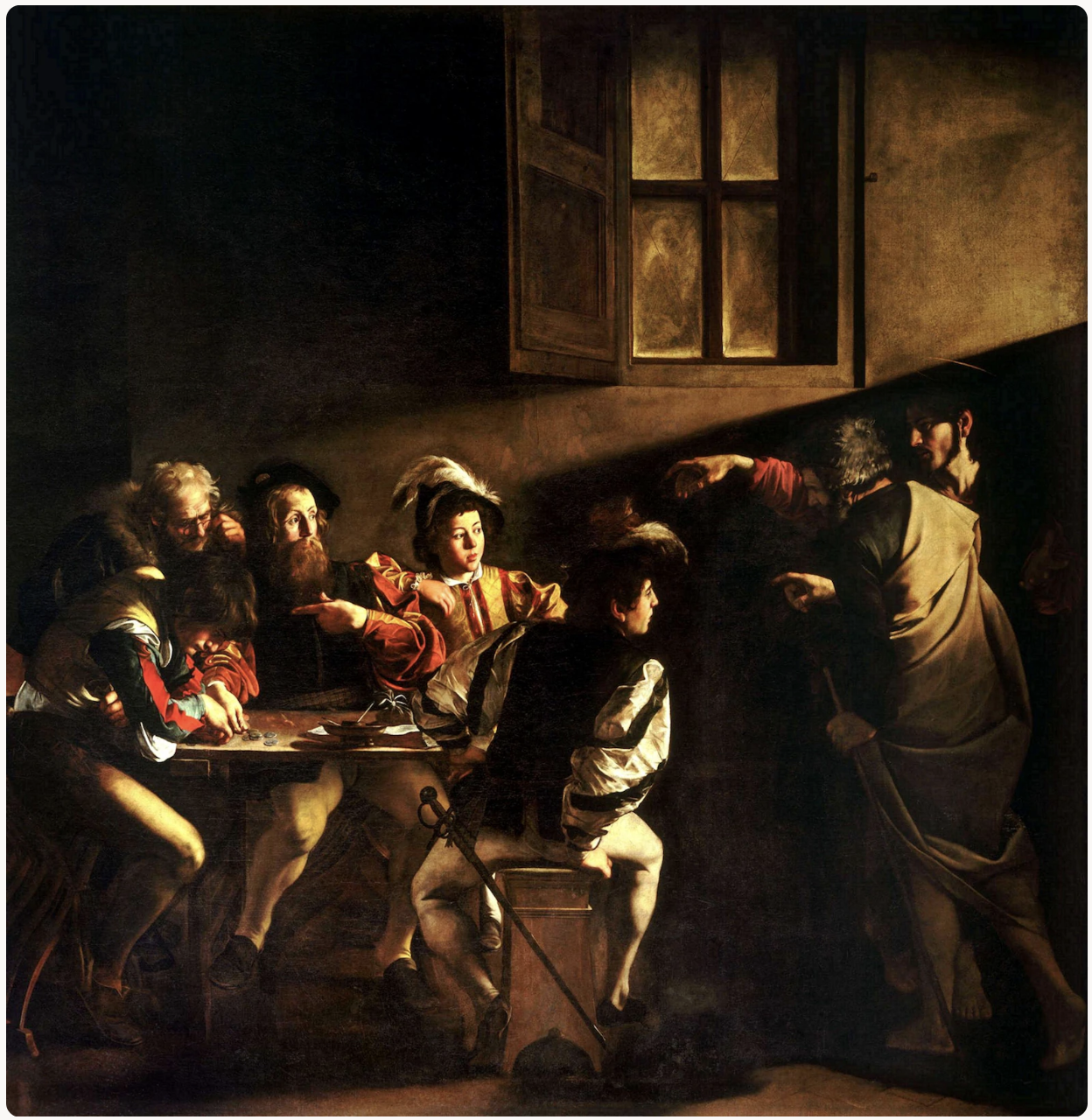
Caravaggio, The Calling of Saint Matthew, 1599–1600, oil on canvas, Contarelli Chapel, San Luigi dei Francesi, Rome

Overview

About This Work

The Calling of Saint Matthew is Caravaggio's breakthrough into large-scale public religious painting and the work that made his European reputation overnight. Completed between July 1599 and July 1600 for the left wall of the Contarelli Chapel in San Luigi dei Francesi (the church of the French community in Rome), it hangs opposite The Martyrdom of Saint Matthew and flanks the altarpiece The Inspiration of Saint Matthew (1602). The commission was secured for Caravaggio by his patron Cardinal Francesco Maria del Monte, whose connections to the French community in Rome gave him access to the chapel's longstanding but frustrated decoration program. The subject was prescribed: the moment described in Matthew 9:9 when Christ, walking by, sees the tax collector Levi sitting at the customs post and says simply, "Follow me." Caravaggio's response — setting this divine encounter in a contemporary Roman tax office, with Christ and Peter in timeless biblical robes encountering a group of men in fashionable 1590s doublets and hats — was an immediate sensation.

Visual Analysis

Composition

The painting's composition is divided into two contrasting groups. On the left, five men sit around a table counting money: one elderly, hunched, peering through spectacles at the coins; one youth still absorbed in his work; the central figure gesturing in puzzlement; one young man in a feathered hat looking toward the door. On the right, Christ and Peter — the only figures in timeless biblical dress — stand in the doorway, Christ extending his arm. The contrast between the fashionable, absorbed money-counters and the simply dressed figures of eternal salvation is the painting's ideological argument made visible: the world of material preoccupation and the world of divine grace confront each other across the diagonal of light. The question of which figure is Matthew has occupied scholars for centuries and remains unresolved. The most common reading identifies the bearded, middle-aged man in the centre who points at himself questioningly — "me?" — as Matthew. But an alternative reading (argued by art historian Sara Magister) identifies the young man at the far left, his face half in shadow and still bent over his coins, as the true subject of the call. A third reading suggests Matthew is the figure with his head bowed at the far left, still absorbed in counting, unaware of the divine presence. The ambiguity is not a flaw in the composition but its intellectual richness: Caravaggio refuses to provide easy iconographic identification, forcing the viewer to engage actively with the question of who is being called — and by extension, to ask themselves whether they too are being called.

Colour & Light

The painting's most celebrated formal achievement is the diagonal shaft of light that enters from the upper right — from above and beyond Christ's extended arm — and falls across the group at the table. This light does not enter through the window visible in the upper left of the composition; it comes from an invisible source that coincides with Christ's direction of approach. Britannica's analysis identifies the light beam's compositional function as an abstract diagram of Matthew's traditional symbol — the balance or set of scales: "Christ's divine light will lever him upward, making his soul light and enabling him to rise out of base darkness." The light is both naturalistic (it behaves as a shaft of daylight entering a dim room) and theological (it is the light of divine grace, falling selectively on those who are called). This double function — naturalistic and symbolic simultaneously — is the defining achievement of Caravaggio's tenebrism as a theological instrument.

Materials & Technique

Caravaggio places the scene in what Britannica describes as "a dingy modern tax collector's office somewhere in a basement of Rome." The room is entirely non-specific — a bare wall, a shuttered window, a plain table — nothing that signals biblical time or sacred space. The only indication that something extraordinary is happening is the shaft of light that bisects the composition diagonally from the upper right and the robed figures of Christ and Peter who stand in the doorway. The five men at the table wear contemporary dress — slashed doublets, feathered hats, the fashionable clothing of prosperous young Romans. This temporal translation — placing the New Testament narrative in the present — directly served the Counter-Reformation program.

Historical Context

Context

The Contarelli Chapel commission was the key to Caravaggio's career advancement. Cardinal Cointrel had left funds in his will in the 1560s for the chapel's decoration, specifying subjects related to his namesake saint. Decades of failed attempts — including an incomplete fresco cycle by Girolamo Muziano (1565) and a proposed altarpiece group by the Flemish sculptor Jacob Cobaert — had left the chapel undecorated until the late 1590s, when Cardinal del Monte used his connections to secure the commission for Caravaggio. Del Monte's patronage is the key to understanding how Caravaggio — a relatively unknown painter without established public commissions — obtained this major opportunity. Del Monte had housed Caravaggio since approximately 1595, providing him with lodgings, introductions to Roman aristocratic circles, and commissions for intimate devotional and secular works. The Contarelli commission was the reward for this relationship and the launch of Caravaggio's public career. The paintings were delivered in July 1600 and were immediately celebrated — Caravaggio "never lacked commissions or patrons" thereafter, according to historical accounts.

Key Themes

Sacred and Profane; Divine Encounter; Material Life and Spiritual Transformation

The Tridentine requirement for accessible, emotionally immediate religious imagery is fulfilled with radical completeness: Christ is calling Matthew now, in Rome, among people who look like the congregation of San Luigi dei Francesi. The divine enters the ordinary without ceremony, announcement, or visual grandeur. Christ's pointing gesture — extended arm, relaxed hand — directly echoes the hand of God creating Adam in Michelangelo's Sistine Chapel ceiling. The echo is deliberate and profound: just as God called Adam into being from formlessness, Christ calls Matthew into a new life from the deadness of material preoccupation. The gesture is both divine command and gentle invitation.

Exam Focus Points

Critical Perspectives

The echo of Michelangelo's Creation of Adam in Christ's gesture was identified early and remains the painting's most discussed intertextual reference. It elevates the depicted moment from a biographical incident in Matthew's life to a theological universal: the call as a paradigm of divine-human encounter, analogous to the original creation. The comparison also positions Caravaggio in explicit dialogue with the greatest artistic achievement of the previous century — an audacious claim for a painter still in his late twenties at the commission's completion. Lavin's 1993 essay for the Institute for Advanced Study (Past-Present) provides one of the most rigorous scholarly analyses of the composition's formal structure, tracing the relationship between the youth's "coin-hoarding hand" and the question of Matthew's identity — a critical text directly relevant to detailed engagement with scholarly literature on this work's formal and theological dimensions. Christ's partial concealment behind Peter is an extraordinary compositional choice: we see Christ's extended arm and part of his face while Peter stands slightly in front of him, as if mediating or perhaps concealing. This partial revelation — the divine figure not fully visible, apprehended indirectly through its effects (the light, the gesture, the response of those called) — reflects sophisticated Tridentine theology of divine grace: God acts invisibly, through secondary causes, in the ordinary conditions of human life.

On this page

OverviewVisual AnalysisHistorical ContextKey ThemesExam Focus Points