History of (tagg)Art...
HomeNatureIdentityRenaissanceBaroque

Nature

  • All Nature artworks
  • Landscape or Seascape in 2D
  • Animals in 2D or 3D
  • The Elements (Fire, Water, Wind or Earth) in 2D or 3D
  • +3 more topics

Identity

  • All Identity artworks
  • The Divine in 2D or 3D Works
  • Portraits in 2D Works
  • Portraits in 3D Works
  • +3 more topics

Renaissance

  • All Renaissance artworks
  • Religious Painting
  • Religious Sculpture
  • Mythological in 2D or 3D
  • +3 more topics

Baroque

  • All Baroque artworks
  • Religious Painting
  • Religious Sculpture
  • Mythological Painting
  • +6 more topics

About

A comprehensive study resource for Pearson Edexcel History of Art A-Level.

NatureIdentityRenaissanceBaroque

History of (tagg)Art... - A-Level Study Resource

Pearson Edexcel Specification

Admin
  1. Home
  2. Baroque
  3. The Penitent Magdalene

The Penitent Magdalene

Caravaggio, c.1594-1595
BaroqueReligious PaintingItalian Artists
The Penitent Magdalene by Caravaggio
Caravaggio, The Penitent Magdalene, c. 1594–1595, Oil on canvas, 122.5 × 98.5 cm, Galleria Doria Pamphilj, Rome

Overview

About This Work

The Penitent Magdalene is among Caravaggio's earliest surviving religious paintings and one of the most radical reimaginings of a popular Counter-Reformation subject in the entire Baroque period. Completed around 1594–1595 while Caravaggio was residing with the Lombard churchman Fantin Petrigiani — and almost certainly commissioned by Pietro Vittrice, guardaroba (keeper of the wardrobe) of Pope Gregory XIII — it established the template for Caravaggio's approach to sacred narrative: the complete rejection of idealized, classical precedent in favour of ordinary, psychologically specific humanity observed directly from life. The painting was sufficiently celebrated to enter the collection of Prince Pamphilj, where the biographer Gian Pietro Bellori encountered it — and significantly misread it — in the seventeenth century. It remains in the Galleria Doria Pamphilj, Rome to this day.

Visual Analysis

Composition

The composition is deceptively simple — almost aggressively so. A young woman sits alone on a low stool in a shallow, cave-like interior space, her body turned slightly inward, her head bowed so deeply that her face is seen almost entirely from above. There is no architectural backdrop, no elaborate landscape, no celestial vision — nothing of the standard visual apparatus that identified this subject in the painting traditions of Titian, Tintoretto, or Guido Reni. The figure occupies the lower half of the canvas; above her, a large dark void dominates — a triangular area of near-empty space that one scholar aptly described as "painted silence." The composition is organised around a concealed equilateral triangle, with the figure's bowed head forming the apex and her clasped hands the base — a geometric structure that Caravaggio uses repeatedly in his paintings to give focused, concentrated weight to a moment of spiritual transformation. The pose conveys complete withdrawal from the external world: every line of the figure turns inward — the bowed neck, the folded hands, the downward gaze. On the floor beside and before the figure lies a carefully arranged group of objects: a string of pearls, golden clasps and jewellery, and a glass carafe that may contain precious ointment. These are the attributes of Mary Magdalene — the ointment jar from the Gospel account of the anointing of Christ's feet (Luke 7:36-50) and the discarded luxury goods that symbolise the renunciation of her sinful former life. Their placement on the floor — scattered, abandoned, no longer worn or valued — performs the narrative without any overt action: we are shown not the woman still wearing her wealth, but the moment after its rejection.

Colour & Light

A narrow triangle of light falls on the upper wall behind the figure — the only indication of an outside world or a light source. The figure herself sits in warm, diffused illumination that models her face and hands with gentle chiaroscuro rather than the extreme tenebrism of Caravaggio's later work. The light is subtle here — still learning, still drawing on the Lombard tradition rather than deploying the dramatic shaft he would develop for the Contarelli Chapel canvases. The painting's emotional centre is a single tear traced on the Magdalene's cheek — barely visible, yet the pivot of the entire composition. The weeping Magdalene was a canonical subject in Counter-Reformation spirituality: the gift of tears (donum lacrimarum) was considered a special grace, a sign of genuine contrition and spiritual transformation. The tear is not theatrical — it does not wet the face or distort the features. It simply falls, quietly, in the silence of the composition, as evidence of an inner state the figure does not need to perform for our benefit.

Materials & Technique

The objects on the floor are rendered with extraordinary material specificity — the translucency of the glass, the lustre of the pearls, the weight of the clasps — a Lombard naturalistic attention to surface that reflects Caravaggio's training under Peterzano. The Magdalene wears contemporary clothing: a white-sleeved blouse, a yellow tunic, and a richly patterned skirt — the dress of a prosperous young Roman woman of the 1590s, not a biblical figure. This is the heart of Caravaggio's radical departure from tradition. The Magdalene is not shown as the conventionally beautiful semi-naked penitent of Titian's version (1533, Palazzo Pitti) or as a figure in oriental or pseudo-biblical costume; she is a Roman girl, recognisably human, her hands reddened and slightly swollen as if, one Dominican commentator observes, she works as a laundress by day. Her loose, recently washed hair — an attribute of the Magdalene (with which she dried Christ's feet) — hangs naturally rather than dramatically. The absence of a halo is significant: there are none of the standard visual signs of a religious scene at all.

Historical Context

Context

The Penitent Magdalene is a quintessentially Tridentine subject. The Council of Trent had affirmed the veneration of saints explicitly in its final session decree; and the repentant Magdalene — a figure whose story of conversion from sin to complete devotion made her a powerful model for Catholic reform — was among the most popular subjects of Counter-Reformation devotional art. The "gift of tears" was specifically valued within Jesuit and Carmelite spirituality as evidence of sincere contrition — the kind of personally felt, emotionally authentic religious experience that the Counter-Reformation sought to foster against what it characterised as Protestant intellectual coldness. Yet Caravaggio's treatment — in stripping the subject of its conventional beauty, sensuality, and theatrical pathos — also raised questions. The very accessibility of his realism (making the Magdalene look like an ordinary Roman girl) risked crossing from devotional accessibility into irreverence. The tension between these poles — the requirement for emotionally direct, accessible images and the requirement for appropriate devotional gravity — would define the reception of Caravaggio's religious work throughout his career, culminating in the rejections of the first St Matthew and the Angel (c. 1599-1600) and the Death of the Virgin (1605-06). The biographer Bellori — a champion of classical idealism — regarded the religious title as an "excuse" and read the painting as merely a naturalistic genre scene. This misreading (from Caravaggio's own century) reveals how destabilising the work was: by stripping the subject of all conventional religious apparatus, Caravaggio had made the Magdalene almost unrecognisable as a sacred figure, forcing the viewer to read her spiritual state through her posture, her expression, and the discarded objects alone.

Key Themes

Influence and Legacy

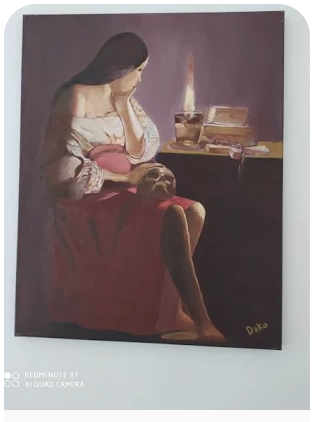
The painting's influence extended to Georges de La Tour, who produced multiple versions of the seated Magdalene by candlelight — dramatically transforming Caravaggio's diffused daylight into a single nocturnal candle flame, but preserving the essential compositional structure of the solitary, inward-turned figure in meditation. Caravaggio's radical naturalism — presenting sacred figures as ordinary, recognisable human beings — established a template that would influence religious painting throughout the Baroque period and beyond. The tension between accessibility and reverence that this painting embodies became a central concern for Counter-Reformation art.

Exam Focus Points

Critical Perspectives

The Jesuit poet Giuseppe Silos praised the work's spiritual authenticity, while Bellori dismissed it as mere genre painting with added props. In the twenty-first century, John Varriano (2006) identifies the work's defining quality as its deliberate avoidance of "the pathos and languid sensuality" with which the Magdalene was conventionally depicted. Hilary Spurling (New York Times Book Review, 2001) observed that "contemporaries complained that his Mary Magdalene looked like the girl next door drying her hair at home on her night in" — a response that reveals precisely the naturalistic shock Caravaggio intended and achieved. The work demonstrates Caravaggio's early establishment of the principles that would define his mature religious painting: the rejection of idealization, the use of contemporary models and clothing, the stripping away of conventional religious apparatus, and the focus on psychologically specific, interiorized spiritual states rather than theatrical displays of emotion.

On this page

OverviewVisual AnalysisHistorical ContextKey ThemesExam Focus Points