History o' Phoeart
  • Home

Nature

  • Overview
  • Landscape or Seascape in 2D
  • Animals in 2D or 3D
  • The Elements (Fire, Water, Wind or Earth) in 2D or 3D
  • The Relationship between Man/Woman and Nature in 2D or 3D

Identity

  • Overview
  • The Divine in 2D or 3D Works
  • Portraits in 2D Works
  • Portraits in 3D Works
  • Gender Identity in 2D or 3D Works

Renaissance

  • Overview
  • Religious Painting
  • Religious Sculpture
  • Mythological in 2D or 3D
  • Portraits in 2D or 3D

Baroque

  • Overview
  • Religious Painting
  • Religious Sculpture
  • Mythological Painting
  • Mythological Sculpture

About

A comprehensive study resource for Pearson Edexcel History of Art A-Level.

NatureIdentityRenaissanceBaroque

History o' Phoeart - A-Level Study Resource

Pearson Edexcel Specification • Use ⌘K to search

  1. Home
  2. Paper 1
  3. Nature
  4. Plants in 2D or 3D
  5. Sunflowers
Paper 1Nature
Nature
Landscape or Seascape in 2D
Animals in 2D or 3D
The Elements (Fire, Water, Wind or Earth) in 2D or 3D
The Relationship between Man/Woman and Nature in 2D or 3D
Plants in 2D or 3D
Pre-1850
Post-1850
Sunflowers

Sunflowers

Vincent Van Gogh

Non-Western
Architecture

6 scopes • 24 artworks

Sunflowers

Vincent Van Gogh, 1888
NaturePost-1850
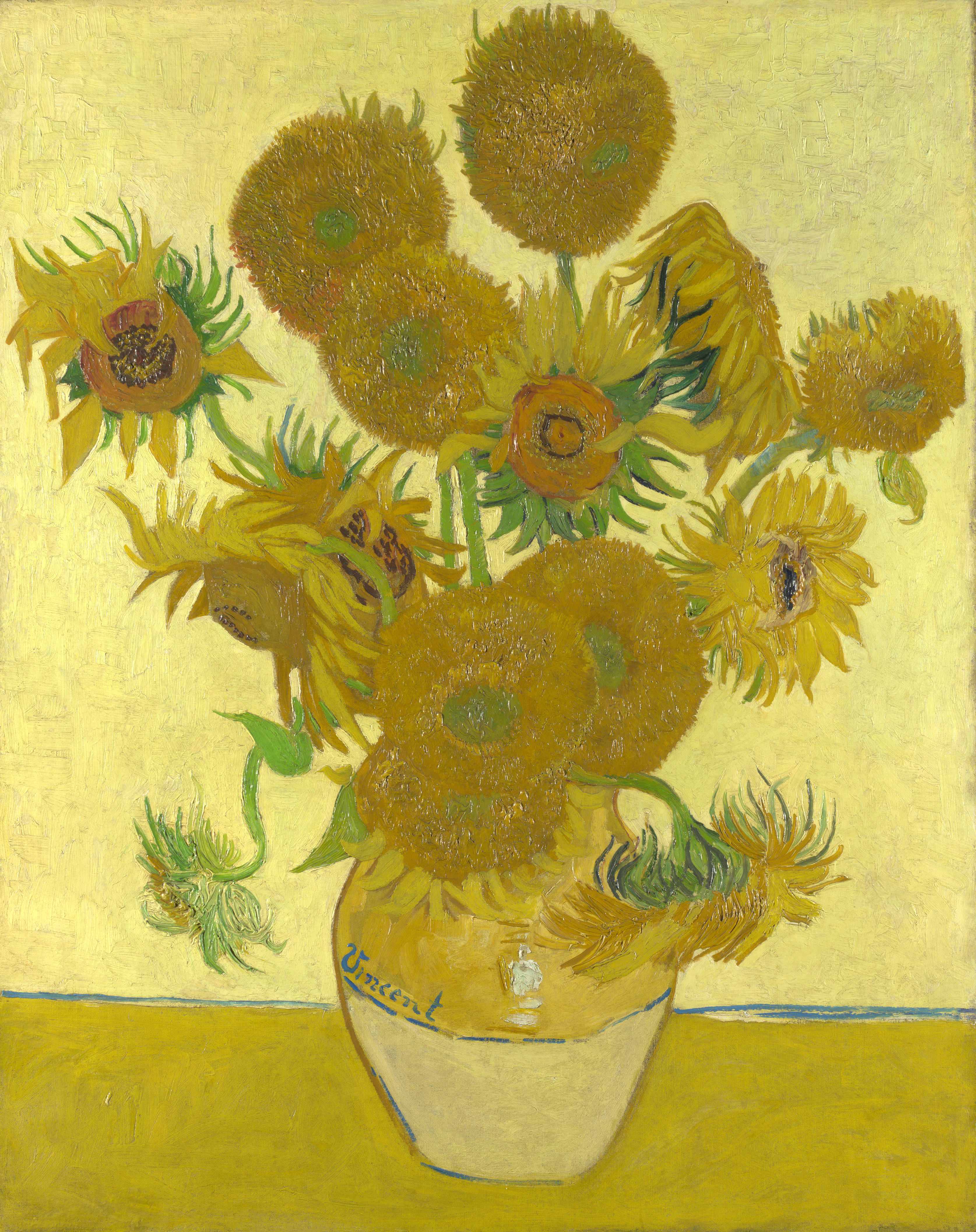
Sunflowers by Vincent Van Gogh
Vincent van Gogh, Sunflowers, 1888. Oil on canvas, 93 x 73.5 cm. National Gallery, London.

Overview

About This Work

Sunflowers (1888) is one of the most iconic and beloved paintings in Western art history. Van Gogh created an entire series of eleven paintings depicting sunflowers, executed across three distinct periods (Paris 1887; Arles 1888; Saint-Remy and Paris 1889-1890). The versions vary significantly in composition, colour, and background, but all share an obsessive exploration of yellows and the symbolic potential of the sunflower. The most celebrated version (often called the London version) measures 93 x 73.5 cm (oil on canvas) and is housed at the National Gallery, London. This painting depicts a simple yet vibrant arrangement of sunflowers in a pale yellow vase against a pale yellow background, with some flowers in full, radiant bloom and others beginning to wilt and decay. Van Gogh considered the sunflowers to be his flower, declaring: The sunflower is mine. The series was explicitly created to decorate the walls of his Yellow House in Arles, where he hoped to establish a Studio of the South - a community of artists working together. The Sunflowers sequence represents Van Gogh's most sustained exploration of colour as an independent artistic means of expression, exemplifying Post-Impressionist dedication to emotional and symbolic truth over optical naturalism.

Visual Analysis

Composition

Deceptive Simplicity: The composition appears straightforward: a cluster of sunflowers arranged in a vase, rendered against a relatively uniform background. Yet beneath this simplicity lies sophisticated pictorial organisation. The flowers are not symmetrically balanced but arranged in a dynamic, organic composition that suggests natural growth rather than artifice. Variation in Bloom Stages: Crucially, Van Gogh depicts sunflowers at different stages of maturity. Some are in full, radiant bloom with tightly packed seed heads and wide-open petals; others are drooping, their petals beginning to fall, revealing the brown/black seed head beneath. This temporal progression - from youth to age, vitality to decay - is integral to the work's meaning. The Vase as Anchor: The pale yellow vase provides a stable base, its cylindrical form contrasting with the organic, irregular forms of the flowers. The vase is transparent to shadow, suggesting its glassy material, yet is rendered simply without elaborate detail. It does not compete with the flowers for visual attention. Spatial Ambiguity: The background is flattened - there is no clear spatial recession or atmospheric perspective. The background yellow is similar in tonality to the flowers, creating a unified colour field that erases the boundary between figure and ground. This flattening is characteristic of Post-Impressionism and Japanese influence.

Colour & Light

The Domination of Yellow: The painting is a monocolor study in yellows. Van Gogh uses what he described as the three chrome yellows, yellow ochre, and nothing else (letter 736). The petals range from pale, creamy yellows to rich, golden, almost orangish yellows. The seed heads are rendered in darker ochres and browns. Even the background is a softer, paler yellow. Complementary Contrast: Within the yellows, Van Gogh introduces subtle complements. Pale blue-green appears in the stem shadows and vase contours, creating gentle contrast against the yellows without disrupting the painting's cohesive colour unity. The blue is restrained, serving to enhance rather than dominate. Light as Colour: In Sunflowers, light is not represented through traditional chiaroscuro (dark shadows defining volume), but through colour modulation. Lighter yellows suggest illumination; darker ochres suggest shadow. The painting glows with internal luminosity - the flowers appear to radiate light from within. Emotional Intensity: Van Gogh associated yellow with warmth, happiness, and spiritual intensity. He wrote about his desire to create colours that would express emotion and evoke feeling in the viewer. The intense yellows are not naturalistic (real sunflowers are darker) but emotionally heightened - expressing Van Gogh's psychological state rather than botanical reality. Scientific Analysis of Colour Aging: Modern conservation science has revealed that the yellows have darkened significantly with age, due to the oxidation of chrome yellow pigment (which darkens as it ages). The original painting would have been even more intensely, brightly yellow - nearly overwhelming in its chromatic intensity.

Materials & Technique

Impasto Application: Van Gogh applies paint with extraordinary impasto - paint is applied thickly, sometimes with a palette knife, creating visible ridges and texture on the canvas surface. The paint surface is sculpted, creating actual three-dimensionality. Light catches these ridges, creating dynamic interplay of highlight and shadow. Directional Brushwork: The brushstrokes follow the contours of petals and seed heads, creating a sense of organic movement. Petals are rendered with curved, undulating strokes; stems with straighter, vertical strokes. This directional application infuses the composition with vitality and energy. Multiple Versions and Repetition: Van Gogh painted multiple versions of the sunflowers composition, deliberately exploring variations. He wrote: I want to paint repetitions of this, like some of the hues change (letter 749). The repetitions were meant to be equivalent and identical (letter 736), yet each varies subtly in colour, arrangement, and background tonality. This seriality anticipates modern art practices. Studio Synthesis: Unlike Impressionists who painted en plein air, Van Gogh worked from memory and imagination, using real sunflowers as initial references but transforming them in the studio. The painting is a synthesis of observation and emotional interpretation - not a botanical study but a spiritual expression.

Historical Context

Context

The Yellow House and the Studio of the South: In 1888, Van Gogh rented a yellow stucco house in Arles, southern France. He envisioned establishing a Studio of the South - a utopian artist community where painters could live and work together, sharing ideas and providing mutual support. He purchased furniture, decorated the walls with his paintings, and eagerly awaited the arrival of Paul Gauguin, whom he admired greatly. Personal Symbolism and Friendship: The Sunflowers were explicitly created to decorate the walls of the Yellow House, particularly Gauguin's guest room. Van Gogh wrote to Theo: The Sunflowers are mine; they are the vision of the friends (letter 626). The paintings symbolized both gratitude for Gauguin's anticipated companionship and Van Gogh's longing for artistic community and emotional connection. Gauguin did arrive in October 1888, but their cohabitation was fraught with tension and ended in tragedy (Van Gogh's ear-cutting incident in December). Mental Health and Emotional State: The Sunflowers were created during a period of relative emotional stability (summer 1888) following Van Gogh's arrival in Arles, yet they carry latent melancholy. The wilting flowers and drooping petals suggest decay even amid vibrant bloom - a visual metaphor for Van Gogh's precarious psychological equilibrium. Colour Theory Experimentation: The Sunflowers series represents Van Gogh's most systematic exploration of colour theory, influenced by his reading of Michel Eugene Chevreul's The Principles of Harmony and Contrast of Colours. Van Gogh was consciously experimenting with monochromatic, analogous colour schemes to create emotional and symbolic effects. Post-Impressionist Context: The Sunflowers exemplify Post-Impressionism's move beyond optical naturalism. Rather than recording light effects (as Monet did), Van Gogh prioritizes emotional expression and symbolic meaning through deliberately distorted, heightened colours and emphatic brushwork.

Key Themes

Connection to Nature

Life and Decay: The painting presents a meditation on the cycles of life and death. Flowers in full bloom represent vitality, beauty, and hope; wilting flowers represent inevitable decline. Van Gogh depicts multiple generational stages - youth, maturity, age, decay - within a single composition, suggesting that all living things move through these cycles. The Sunflower as Self-Portrait: Some scholars interpret the sunflowers as metaphors for Van Gogh himself. The flower's heliotropic behaviour (turning to follow the sun) parallels Van Gogh's emotional dependence and search for light and meaning. The bright yellows express optimism; the drooping petals express despair. Gratitude and Love: Van Gogh explicitly associated sunflowers with feelings of gratitude and love. He wrote: I am always inclined to see something touching in the obstinate efforts of an insignificant little flower struggling against the difficulties of its existence (letter 626). The painting is a love poem to his absent friend and to artistic companionship. Nature's Essential Forms: Like the Impressionists, Van Gogh celebrated nature's beauty, yet unlike them, he transformed it through subjective intensity. The sunflowers are more alive, more vivid, more emotionally resonant than reality - art transcends nature through emotional force.

Exam Focus Points

Critical Perspectives

The Myth vs. The Reality: The Sunflowers have become mythology in art history, representing Vincent's joy, optimism, and genius. Yet the historical context reveals more complexity: the paintings were created amid isolation, longing, and precarious mental health. The vibrant yellows express aspiration and hope, but also mask darker emotional realities. A sophisticated response should engage this tension. Commodity and Speculation: Ironically, the Sunflowers - painted by an impoverished artist with virtually no recognition - have become among the most expensive artworks ever sold. In 1987, a version sold at Christie's for 24.75 million pounds (approximately 65 million pounds in 2025 value). This massive market value contrasts sharply with Van Gogh's lifetime poverty and lack of commercial success. Does the painting's value rest in its artistic achievement or in market speculation and cultural mythologizing? Colour as Autonomous: Van Gogh's use of colour in Sunflowers was radically avant-garde. He employs colours not to describe botanical or naturalistic facts, but to express emotion and spiritual states. This autonomy of colour - colour as independent artistic language rather than descriptive tool - influenced modernism fundamentally and was taken further by the Fauves, Expressionists, and eventually Abstract Expressionists. The Serial Artwork: The Sunflowers series - multiple paintings exploring variations on a single theme - anticipates modern and contemporary art practices (Monet's haystacks, Warhol's silkscreens, contemporary installation). The series format suggests that no single definitive version exists; meaning emerges through comparison and variation. Comparison to Ruysch's Flowers: Both Van Gogh's Sunflowers and Ruysch's Flowers in a Glass Vase depict flowers in vases, yet their approaches differ fundamentally. Ruysch emphasizes botanical precision, scientific detail, and the classical ideal of perfect arrangement; Van Gogh emphasizes subjective intensity and emotional expression.

On this page

OverviewVisual AnalysisHistorical ContextKey ThemesExam Focus Points