History o' Phoeart
  • Home

Nature

  • Overview
  • Landscape or Seascape in 2D
  • Animals in 2D or 3D
  • The Elements (Fire, Water, Wind or Earth) in 2D or 3D
  • The Relationship between Man/Woman and Nature in 2D or 3D

Identity

  • Overview
  • The Divine in 2D or 3D Works
  • Portraits in 2D Works
  • Portraits in 3D Works
  • Gender Identity in 2D or 3D Works

Renaissance

  • Overview
  • Religious Painting
  • Religious Sculpture
  • Mythological in 2D or 3D
  • Portraits in 2D or 3D

Baroque

  • Overview
  • Religious Painting
  • Religious Sculpture
  • Mythological Painting
  • Mythological Sculpture

About

A comprehensive study resource for Pearson Edexcel History of Art A-Level.

NatureIdentityRenaissanceBaroque

History o' Phoeart - A-Level Study Resource

Pearson Edexcel Specification • Use ⌘K to search

  1. Home
  2. Paper 1
  3. Nature
  4. The Relationship between Man/Woman and Nature in 2D or 3D
  5. A Line Made by Walking
Paper 1Nature
Nature
Landscape or Seascape in 2D
Animals in 2D or 3D
The Elements (Fire, Water, Wind or Earth) in 2D or 3D
The Relationship between Man/Woman and Nature in 2D or 3D
Pre-1850
Post-1850
A Line Made by Walking

A Line Made by Walking

Richard Long

Plants in 2D or 3D
Architecture

6 scopes • 24 artworks

A Line Made by Walking

Richard Long, 1967
NaturePost-1850
A Line Made by Walking by Richard Long
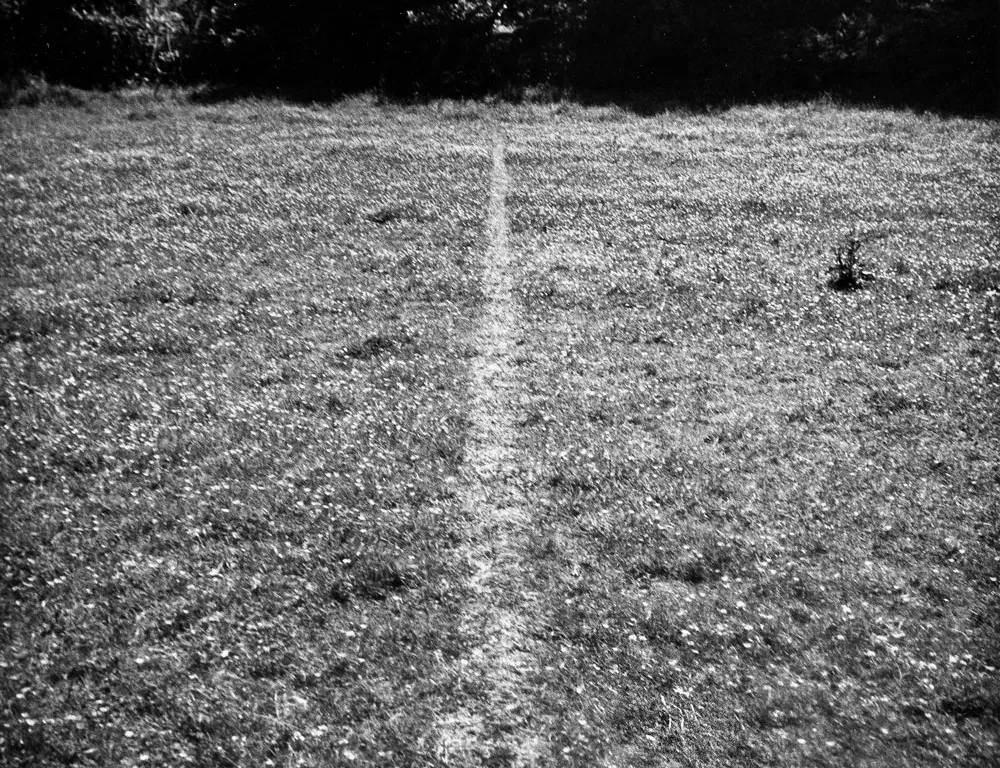
Richard Long, A Line Made by Walking, 1967, photograph, 82.5 x 112.5 cm, Tate Collection

Overview

About This Work

A Line Made by Walking (1967) is a foundational artwork in Land Art and Conceptual Art, created when Richard Long was a 22-year-old art student at Saint Martin's School of Art in London. The work documents a deceptively simple action: Long walked repeatedly back and forth in a straight line across a grassy field in Wiltshire, England, creating a visible path of flattened grass. He then photographed the result from an angle at which the sunlight illuminated the trampled line against the surrounding grass. The final work comprises a black and white photograph mounted on board, measuring 82.5 x 112.5 cm, with handwritten text in red pencil stating "A LINE MADE BY WALKING" and in graphite pencil "ENGLAND 1967". The work is held in the Tate Collection and the National Galleries of Scotland. Despite—or because of—its apparent simplicity, this work revolutionized contemporary art by asserting that art could be created through the most basic human act (walking) in the most ordinary landscape (a featureless field), and that the primary artistic medium was not physical material but the documentation of an ephemeral intervention. It announced that process, performance, and conceptual meaning could constitute art even without a lasting, crafted object.

Visual Analysis

Composition

The Photograph as Primary Medium: Crucially, the photograph is not merely documentation of a pre-existing artwork; the photograph is the artwork. The line itself (the trampled grass) exists only temporarily and has likely decomposed entirely in the 50+ years since its creation. The photograph is the sole surviving evidence. This makes photography the primary artistic medium, not the line itself. Linear Perspective and Recession: The photograph presents a straight line receding toward the horizon, utilizing classical linear perspective to create spatial depth. The line appears to recede infinitely, suggesting endlessness and infinity. Yet the line terminates at a hedge or stand of trees, creating a finite boundary that contradicts the suggestion of infinity. Cropping and Frame: The photograph is tightly framed, eliminating extraneous landscape. This crops away any identifying features and emphasizes the line itself as the primary content. The result is an abstracted, universal image—not a specific place but an archetypal line. Angle of Light: Long photographed the line from a specific angle at which sunlight created dramatic contrast between the trampled (darker) grass and the surrounding upright (lighter) grass. This lighting is essential; from other angles, the line would be nearly invisible. This emphasizes that the artwork is dependent on external conditions (light, angle of view) beyond the artist's direct control.

Colour & Light

Monochromatic Photographic Medium: The work is rendered in black and white, eliminating colour information and emphasizing tonal relationships. The monochromatic medium emphasizes the work's conceptual rather than sensory appeal. The photograph's austere, impersonal aesthetic is characteristic of Conceptual Art practice. Minimal Tonal Range: The photograph exhibits relatively restricted tonal range—greys, dark greens, blacks, and whites. There are no vibrant colours or dramatic chiaroscuro. This restraint emphasizes the work's anti-aesthetic ideology (deliberately rejecting traditional notions of beauty and visual pleasure). Graininess and Photographic Texture: The photograph exhibits visible grain and photographic texture, typical of archival gelatin silver prints. This materiality reminds viewers they are viewing a photograph, not looking directly at the original line. The photograph becomes an object in itself, not a transparent window onto nature.

Materials & Technique

The Body as Primary Tool: Unlike traditional sculpture that carves or constructs objects, A Line Made by Walking uses the artist's own body as the primary creative tool. The repeated walking is the artwork; the line is merely a trace of that action. Minimal Intervention in Nature: The "mark" made—trampled grass—is created without tools, machinery, or materials. It is the simplest possible intervention, emphasizing the anti-craft ideology of Conceptual Art. No skill in the traditional sense (carving, joining, moulding) is required. Ephemeralness: The line is inherently temporary. Grass regenerates; rain erases the evidence; weather destroys the trace. This embrace of impermanence contrasts sharply with the Western tradition's valorization of durable, permanent artworks. The work accepts that it will disappear; the photograph becomes the only permanent record. Documentation as Artistic Practice: The photograph and text constitute the complete artwork. The artist's documentation of the action is as important as the action itself. This elevated documentation to the status of art—a radical assertion in 1967, before digital photography and social media documentation made image-making ubiquitous.

Historical Context

Context

Saint Martin's School of Art: Long created this work while a student in one of London's most progressive art schools, where his contemporaries included Gilbert & George, Barry Flanagan, and Hamish Fulton. The school's environment fostered experimentation with unconventional materials and processes. Long was particularly influenced by minimalist sculpture (Carl Andre's floor works) and began conceptualizing walking as a sculptural medium. Emergence of Land Art: A Line Made by Walking is among the earliest Land Art works, predating Robert Smithson's monumental Spiral Jetty (1970) and Michael Heizer's Double Negative (1969–70). However, Long's approach is fundamentally different from American Land Art: American land artists used bulldozers and heavy machinery to create massive, permanent alterations to landscapes; Long uses only his body and creates impermanent marks. This represents a more ecological, non-invasive approach to landscape engagement. Conceptual Art Movement: The work emerged during the early phases of Conceptual Art, a movement prioritizing artistic ideas over crafted objects. Artists like Joseph Kosuth, Lawrence Weiner, and Sol LeWitt were asserting that art could exist primarily as concept, instruction, or documentation rather than as a physical commodity. A Line Made by Walking exemplifies this ideology: the "artwork" is essentially immaterial (a set of instructions: "walk back and forth to create a visible line"). Anti-Art and Anti-Craft: The work rejects traditional notions of artistic skill, originality, and the crafted object. It asserts that anyone can make art (you don't need specialized training), that repetitive, mundane actions constitute art, and that the art market's emphasis on durable, collectible objects is unnecessary. This anti-market stance was politically charged in the late 1960s, during student protests and cultural rebellion against established institutions.

Key Themes

Connection to Nature

Human Mark-Making and Environmental Impact: The work explores the human capacity to alter landscape through simple action. The trampled grass is a trace of human passage—evidence that the artist existed and moved through this space. This raises ecological questions: What traces do we leave on the land? How do human movements impact nature? Walking as Embodied Practice: Unlike visual artists who stand separate from their subject matter, Long's walking makes his body inseparable from the landscape. The line is the artist's own physical path; his footsteps are the artistic "mark." This emphasizes embodied engagement with nature rather than distant, aesthetic contemplation. Nature's Indifference: The work also emphasizes nature's indifference to human artistic intention. The line will decompose; the grass will regrow. Nature is not concerned with preserving human marks. This stands in contrast to Romantic idealization of nature as responsive to human emotion. For Long, nature simply continues its cycles, oblivious to artistic intervention. Repetition and Rhythm: The repeated walking creates the line through accumulated action. This emphasizes process and duration—time spent walking—rather than instantaneous creative gesture. The artwork is an accumulation of movements across time.

Exam Focus Points

Critical Perspectives

Process vs. Product: A Line Made by Walking fundamentally challenges the distinction between process and product. What is the artwork—the walking, the line, or the photograph? By destabilizing these categories, Long asserts that artistic practice (the walking) is as important as the finished artwork (the photograph). The Work Exists in Multiple Forms: Importantly, the work exists in three related but distinct forms: (1) the actual line in the grass (temporary, ephemeral, now destroyed); (2) the photograph (permanent, reproducible, collectible); (3) the concept or idea (eternal, infinitely reproducible in documentation). This creates slippage between the physical work and its documentation, challenging conventional art-historical categories. Anti-Art and the Art Institution: While the work rejects traditional art-market values (uniqueness, durability, craftsmanship), it paradoxically exists in elite institutional collections (Tate, National Galleries of Scotland). This reveals that even "anti-art" becomes absorbed by institutional frameworks. A sophisticated A Level response should acknowledge this irony: Long's anti-institutional gesture has become institutionalized. Photography and Conceptual Art: The work elevates photography from a secondary role (merely documenting a pre-existing work) to primary importance. The photograph is the artwork. This challenged traditional hierarchies that privileged painting and sculpture over photography. It anticipated contemporary art's embrace of photography as a primary artistic medium. Gender and Walking: Some contemporary critics have noted that Long's solitary walking figure is implicitly male. Walking alone through countryside has different cultural significations for men vs. women; for women, solitary walking carries associations with vulnerability and transgression. Feminist art historians (e.g., Miwon Kwon) have explored how land art's narratives of isolated, autonomous walking are gendered masculine. Comparison to Hokusai's Great Wave: Both works document natural phenomena, yet from radically different perspectives. Hokusai carves a monumental image of nature's power; Long creates a minimal intervention that emphasizes human insignificance in nature. Both engage landscape, but through opposite philosophical frameworks.

On this page

OverviewVisual AnalysisHistorical ContextKey ThemesExam Focus Points