History o' Phoeart
  • Home

Nature

  • Overview
  • Landscape or Seascape in 2D
  • Animals in 2D or 3D
  • The Elements (Fire, Water, Wind or Earth) in 2D or 3D
  • The Relationship between Man/Woman and Nature in 2D or 3D

Identity

  • Overview
  • The Divine in 2D or 3D Works
  • Portraits in 2D Works
  • Portraits in 3D Works
  • Gender Identity in 2D or 3D Works

Renaissance

  • Overview
  • Religious Painting
  • Religious Sculpture
  • Mythological in 2D or 3D
  • Portraits in 2D or 3D

Baroque

  • Overview
  • Religious Painting
  • Religious Sculpture
  • Mythological Painting
  • Mythological Sculpture

About

A comprehensive study resource for Pearson Edexcel History of Art A-Level.

NatureIdentityRenaissanceBaroque

History o' Phoeart - A-Level Study Resource

Pearson Edexcel Specification • Use ⌘K to search

  1. Home
  2. Paper 1
  3. Nature
  4. The Elements (Fire, Water, Wind or Earth) in 2D or 3D
  5. South Bank Circle
Paper 1Nature
Nature
Landscape or Seascape in 2D
Animals in 2D or 3D
The Elements (Fire, Water, Wind or Earth) in 2D or 3D
Pre-1850
Post-1850
South Bank Circle

South Bank Circle

Richard Long

Non-Western
The Relationship between Man/Woman and Nature in 2D or 3D
Plants in 2D or 3D
Architecture

6 scopes • 24 artworks

South Bank Circle

Richard Long, 1991
NaturePost-1850
South Bank Circle by Richard Long
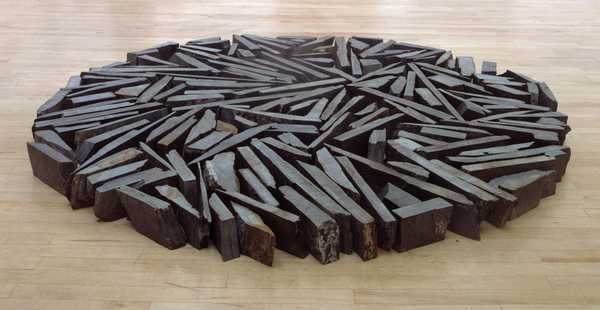
Richard Long, South Bank Circle, 1991, Cornish slate, 168 pieces, approximately 2m diameter, Tate Collection

Overview

About This Work

South Bank Circle (1991) is a land art/minimalist sculpture by British artist Richard Long, created specifically for his comprehensive retrospective exhibition Richard Long: Walking in Circles at the Hayward Gallery on London's South Bank Centre. The work measures approximately 2 metres (1997 mm) in diameter and consists of 168 pieces of rough-cut Cornish slate from the Delabole quarry in Cornwall, arranged in a perfect geometric circle on the gallery floor. The slate pieces are positioned with their smooth surfaces facing upward, creating a unified dark grey circular form that glistens under artificial gallery lighting. Unlike traditional sculpture, which creates new forms from raw materials, South Bank Circle simply arranges existing natural materials into a geometric pattern, exemplifying Long's anti-art, anti-craft approach to sculpture. The work exists as a permanent installation in the Tate Collection, though each exhibition requires Long himself to personally reinstall and reconfigure the pieces according to strict compositional rules he has specified. South Bank Circle encapsulates fundamental themes in Long's practice: the tension between human geometric order and natural material variation, the relationship between human intention and natural forces, and the dematerialization of sculpture through conceptual art strategies. It represents a radical redefinition of sculpture in the late 20th century, challenging conventional notions of artistic skill, creativity, and the distinction between art and nature.

Visual Analysis

Composition

Perfect Geometric Circle: The work is composed as an absolutely regular circle—a mathematical abstraction and fundamental human geometric concept. The circle's perfection contrasts sharply with the irregular, organic character of the individual slate pieces, creating visual tension between human formal intention and natural material variation. Uniformity and Variation: While the overall form is geometrically unified, the individual 168 slate pieces are all different—varying in size, shape, thickness, and surface texture. Long deliberately selects pieces that retain their natural irregular edges (rather than cutting them into identical units), ensuring that no two pieces are identical. This tension between uniformity (the circle) and variation (the pieces) is central to the work's meaning. Tactile Interconnection: Long specifies that every stone must touch the stones adjoining it, creating a "locked" configuration where each piece is physically supported by its neighbours. This interdependence suggests organic community and mutual support—no single piece stands alone; all are interconnected. Surface Orientation: The slate pieces are laid flat with their smooth, polished surfaces facing upward, creating a visually unified, flat plane rather than a textured, varied surface. This deliberate presentation of the smooth geological strata (the natural layering of slate) emphasizes the processed, shaped quality of the material despite its "natural" origin. Horizontal Axis and Spatial Extension: Unlike traditional sculpture that extends upward (emphasizing verticality and monumentality), South Bank Circle extends horizontally along the gallery floor. This horizontal orientation merges sculpture with architecture and spatial design, inviting viewers to walk around the work and experience it from multiple angles.

Colour & Light

Monochromatic Dark Grey: The slate displays a restricted, monochromatic palette—cool, dark greys with subtle tonal variations depending on the individual pieces and the angle of light. This chromatic restraint emphasizes the work's formal geometric structure rather than visual decoration. Glistening Surface and Reflectivity: The polished slate surfaces catch and reflect gallery lighting, creating a subtle luminosity. Long specifically selected slate for its ability to "glisten in the rain," suggesting his engagement with how the work's appearance changes with environmental conditions and lighting. Natural Material as Subject: The slate's geological origin—quarried from the Delabole quarry in Cornwall, one of Britain's major slate-producing regions—is fundamental to the work's meaning. The material carries traces of deep geological time and industrial extraction, grounding the abstract geometric form in material reality and labour.

Materials & Technique

Found Natural Material (Minimally Processed): The slate pieces are "roughly cut" to retain as much natural character as possible. They are not laboriously shaped or refined; instead, Long emphasizes the material's natural irregularity while organizing it according to geometric principles. Simple Arrangement (Not Construction): The work is "made" through arrangement and placement rather than through skilled craft (carving, joining, building). There are no adhesives; the pieces simply rest against each other, held in position by their mutual contact. This simplicity is radically anti-craft, challenging the notion that art requires technical mastery. Dematerialization Through Conceptual Framework: The work's meaning extends beyond the visible arrangement of stones. Long has established specific rules and principles that govern how the pieces should be configured: "All stones should touch; longest and thinnest should be placed in the work's interior, not the edges; overall density should be equal; the work should appear balanced and circular." These rules constitute the conceptual artwork, not merely the visible arrangement. Installation and Reinstallation: Crucially, Long personally installs and reconfigures the work each time it is displayed. Rather than being a permanent, fixed object, the work exists as a set of instructions that Long executes anew with each exhibition. This process-based, performative aspect transforms the sculpture into a documentation of artistic action rather than a finished product.

Historical Context

Context

Land Art and Conceptual Art Movements: South Bank Circle emerges from two overlapping artistic movements: Land Art (also called Earth Art or Land Art), which created large-scale interventions in natural landscapes (typified by Robert Smithson's Spiral Jetty, 1970), and Conceptual Art, which prioritized artistic ideas over finished objects and challenged the distinction between art and non-art. Long's Distinction from American Land Artists: While American land artists (Smithson, Michael Heizer, James Turrell) created monumental, permanent alterations to landscapes using heavy machinery, Long explicitly rejected this heroic, transformative approach. He developed a subtler, more ephemeral practice based on walking and minimal material intervention. As Long states: "I make my work as an individual... There are enormous differences" from prehistoric monuments like Stonehenge, which he rejects as direct ancestors to his practice. The 1991 Retrospective: South Bank Circle was created specifically for Long's 1991 comprehensive retrospective at the Hayward Gallery, his first major institutional retrospective since 1977. This exhibition, designed by Long and displayed across the entire gallery with partition walls removed, presented 25 years of his practice and was regarded as "perhaps the most stunning ever to fill the building." Anti-Art and Postmodern Critique: The work exemplifies postmodern anti-art attitudes—a rejection of the modernist valorization of artistic skill, originality, and the unique artwork. Rather than creating beautiful or skillfully crafted objects, Long uses banal materials (stones, mud, grass) arranged through simple, repeatable principles. This democratic approach suggests that art can emerge from everyday materials and processes rather than requiring specialized artistic training. Environmentalism and Ecological Consciousness: The work emerges during the rise of environmental awareness in the late 20th century. Long's commitment to working with natural materials and respecting natural processes reflects a broader artistic concern with humanity's relationship to nature and the environment—a marked contrast to the domination and exploitation of nature that characterizes industrialization.

Key Themes

Connection to Nature

Man and Nature in Balance: Long explains: "You could say that my work is a balance between the patterns of nature and the formalism of human, abstract ideas like lines and circles. It is where my human characteristics meet the natural forces and patterns of the world." This statement encapsulates the work's central tension: geometric human order imposed upon irregular natural material. Natural Material as Subject: Unlike art that depicts nature or represents natural forms, Long's work uses nature as its medium. The slate's geological origin, its natural colours and textures, and its material properties are not subordinate to the artist's vision but constitute the work itself. Harmony Rather Than Domination: The work proposes a non-exploitative relationship between human creativity and nature. Rather than carving, casting, or violently transforming materials, Long arranges natural elements according to principles that respect their materiality. The stones remain visible as stones; they are not disguised or absorbed into a unified surface. Ephemerality and Impermanence: While South Bank Circle is an indoor installation and technically permanent, Long's outdoor works are often ephemeral—they erode, decompose, or are swept away by weather. This embrace of impermanence challenges the Western art tradition's valorization of permanence and durability. Materials are accepted as subject to time and natural processes.

Exam Focus Points

Critical Perspectives

The Anti-Art Gesture and Institutional Critique: Critic Lucy Lippard argued that Long's work represents a form of institutional critique—by using minimal, undifferentiated materials and simple processes, Long challenges the museum's authority to confer artistic status. If anything can be art (a circle of stones), then the institution's role in defining art becomes questionable. Minimalism and Conceptual Art: South Bank Circle synthesizes Minimalism (its geometric form, its use of industrial/natural materials, its spatial presence) with Conceptual Art (its prioritization of idea over execution, its documentation of process, its engagement with language and rules). The work occupies the boundary between these movements. Authenticity and Craft: The work challenges Romantic notions of artistic authenticity and craftsmanship. Rather than the artist's hand creating something "authentic," Long's process is explicit and repeatable. Does this repeatability undermine artistic authenticity? Or does it reveal authenticity to be a constructed myth? Documentation and Representation: Much of Long's practice exists as documentation—photographs, maps, text accounts of walks—rather than as physical objects. South Bank Circle, by contrast, is an actual material object. Yet even here, the installation process (the reconfiguration each time it is displayed) is as much the work as the finished arrangement. This raises questions about the distinction between process and product in contemporary art. The Gallery Space as Context: The work's meaning shifts depending on its location. Created for the Hayward Gallery's South Bank location (connecting it to an urban, commercial art institution), it references the Delabole quarry in rural Cornwall (connecting it to natural resources and industrial extraction). This geographic and economic connection is intrinsic to the work's meaning. Comparison to Natural Forms: Some critics question whether the work's relationship to nature is genuine or merely theatrical. Is Long's geometric circle fundamentally different from nature's own circles (ripples in water, tree rings, galaxies)? Does the work celebrate nature or impose human order upon it?

On this page

OverviewVisual AnalysisHistorical ContextKey ThemesExam Focus Points