Guggenheim Museum
Frank Lloyd Wright, 1943-59
Overview
About This Work
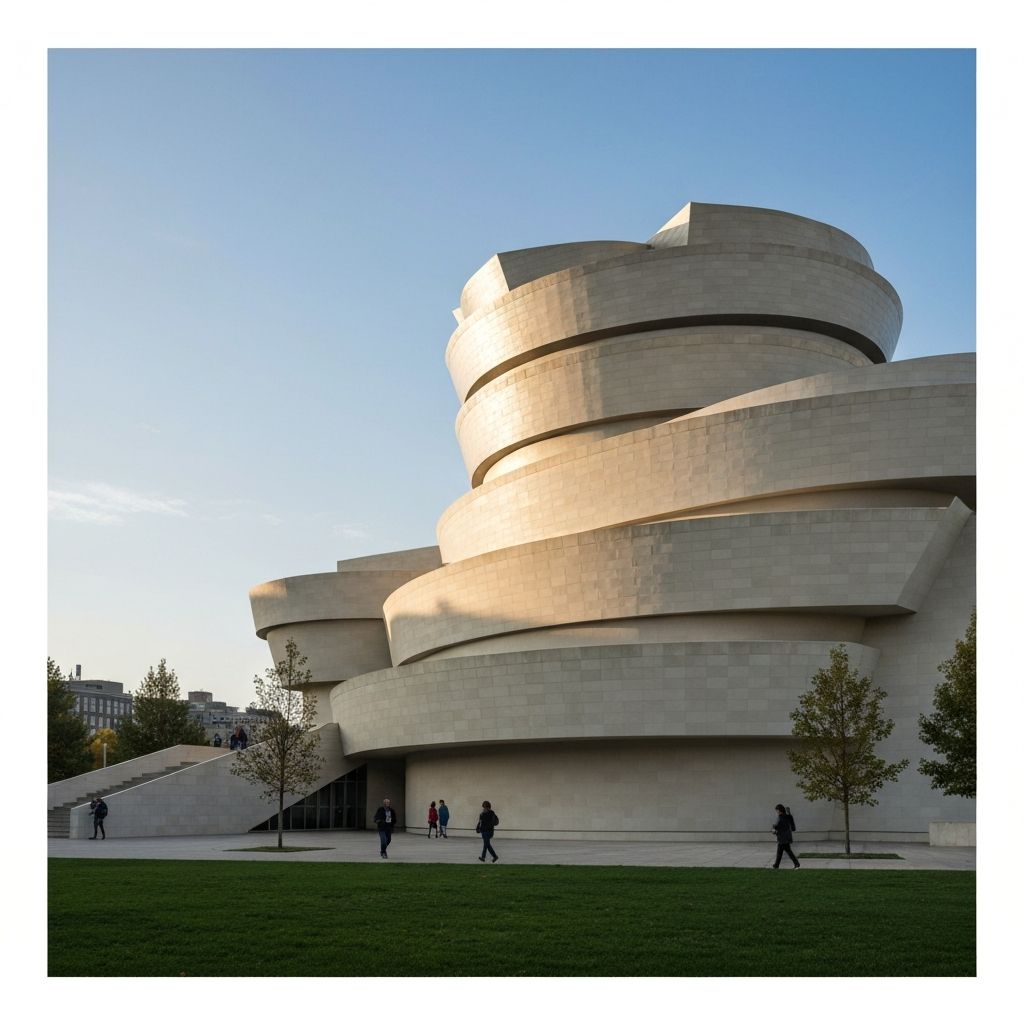
The Solomon R. Guggenheim Museum (1943–1959) is Frank Lloyd Wright's only major public building in New York City and stands as one of the most revolutionary museum designs in architectural history. Located at 1071 Fifth Avenue on Manhattan's Upper East Side, opposite Central Park, the museum opened to the public on October 21, 1959—six months after Wright's death at age 91. The building measures approximately 108 meters (354 feet) in height and comprises a continuous spiral ramp ascending the interior of a cylindrical white concrete structure, crowned by a 58-foot-wide glass oculus (circular opening). The museum was commissioned by the industrialist Solomon R. Guggenheim to house his collection of non-objective (abstract) art. It stands as the culminating achievement of Wright's "organic architecture" philosophy—a design integrating form, function, materials, and human experience into a seamless whole. The spiral ramp itself is the primary exhibition space, with artworks displayed along its continuously ascending wall. The building fundamentally redefined the relationship between architecture and art display, challenging conventions of how museums should function. It remains one of the most recognizable and controversial buildings of the 20th century.