History o' Phoeart
  • Home

Nature

  • Overview
  • Landscape or Seascape in 2D
  • Animals in 2D or 3D
  • The Elements (Fire, Water, Wind or Earth) in 2D or 3D
  • The Relationship between Man/Woman and Nature in 2D or 3D

Identity

  • Overview
  • The Divine in 2D or 3D Works
  • Portraits in 2D Works
  • Portraits in 3D Works
  • Gender Identity in 2D or 3D Works

Renaissance

  • Overview
  • Religious Painting
  • Religious Sculpture
  • Mythological in 2D or 3D
  • Portraits in 2D or 3D

Baroque

  • Overview
  • Religious Painting
  • Religious Sculpture
  • Mythological Painting
  • Mythological Sculpture

About

A comprehensive study resource for Pearson Edexcel History of Art A-Level.

NatureIdentityRenaissanceBaroque

History o' Phoeart - A-Level Study Resource

Pearson Edexcel Specification • Use ⌘K to search

  1. Home
  2. Paper 1
  3. Identity
  4. Portraits in 3D Works
  5. Effigial Tomb of Charlotte Elizabeth Digby
Paper 1Identity
Identity
The Divine in 2D or 3D Works
Portraits in 2D Works
Portraits in 3D Works
Pre-1850
Funeral Monument of the Duke of Marlborough

Funeral Monument of the Duke of Marlborough

John Michael Rysbrack

Effigial Tomb of Charlotte Elizabeth Digby

Effigial Tomb of Charlotte Elizabeth Digby

Sir Francis Chantrey

Post-1850
Gender Identity in 2D or 3D Works
Ethnic Identity in 2D or 3D Works
Identity in Architectural Works

6 scopes • 24 artworks

Effigial Tomb of Charlotte Elizabeth Digby

Sir Francis Chantrey, 1825
IdentityPre-1850
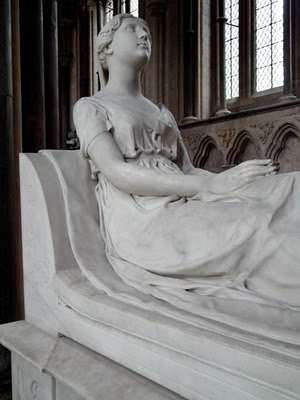
Effigial Tomb of Charlotte Elizabeth Digby by Sir Francis Chantrey
Effigial Tomb of Charlotte Elizabeth Digby, Sir Francis Chantrey, 1825, white Carrara marble, Worcester Cathedral

Overview

About This Work

The Effigial Tomb of Charlotte Elizabeth Digby (1825) is a celebrated marble funerary monument by the leading British sculptor Sir Francis Chantrey (1781–1841). Located in Worcester Cathedral (originally in the Bishop's Chapel, now in the northeast transept), it commemorates Charlotte Elizabeth Digby (1778–1820), a Maid of Honour to Queen Charlotte and wife of the Reverend William Digby. The monument is widely considered one of Chantrey's masterpieces of Romantic sculpture, marking a decisive shift away from the rigid allegories of the Neoclassical era toward a more intimate, sentimental realism. The life-size white marble effigy depicts Charlotte not in death, but reclining on a couch in a state of spiritual beatitude, gazing upward toward heaven. This work exemplifies Chantrey's ability to render stone with softness and pliability, particularly in his famous carving of mattresses and cushions, while capturing a specific psychological state of pious hope.

Visual Analysis

Composition

The Reclining Effigy: Unlike medieval tomb effigies (which lie flat on their backs with hands in prayer) or earlier Neoclassical monuments (often featuring grieving allegorical figures like "Faith" or "Charity"), Chantrey presents the deceased herself as the sole focus. She is shown in a semi-reclining position, propped up by pillows on a mattress. The Heavenward Gaze: The defining feature of the sculpture is the head's position. Charlotte does not look at the viewer or close her eyes in sleep; she tilts her head back and gazes intensely upward. This is not the blank stare of a classical statue but a specific look of rapture and anticipation. It suggests that she is looking beyond the physical world to the spiritual realm, embodying the Christian hope of resurrection. The "Chantrey Mattress": The figure rests on a meticulously carved mattress and pillows. Chantrey was famous for his technical virtuosity in making marble look like soft, yielding bedding. The buttoned mattress depicts the weight of the figure pressing down into it, creating a tactile illusion of softness that contrasts with the hard stone.

Colour & Light

White Marble: The pristine Carrara marble is polished to a soft sheen, mimicking the texture of skin and fabric. Chantrey was a master of light, designing his monuments to catch the ambient light of cathedrals to animate the features. The upward gaze catches the light on the face, emphasizing the spiritual illumination of the subject.

Materials & Technique

Contemporary yet Timeless: Charlotte is dressed in a simple, high-waisted gown characteristic of the Regency period, but the drapery is treated with a classical fluidity that gives it a timeless quality. The folds of the cloth cascade over the edge of the couch, creating a sense of movement and lightness. Naturalism: The sculpture avoids the stiff idealization of Greek revivalism. The posture feels relaxed and naturalistic, capturing the frailty of a woman who died of "rapid consumption" (tuberculosis), yet imbuing her with spiritual strength.

Historical Context

Context

The Subject: Charlotte Elizabeth Digby was the daughter of the Hon. Colonel Stephen Digby and a Maid of Honour to Queen Charlotte (wife of George III). She married the Rev. William Digby in 1803 and died in 1820. Her death was attributed to consumption, a disease often romanticized in the 19th century as a "beautiful death" associated with spiritual sensitivity. Francis Chantrey's Reputation: By 1825, Chantrey was the most sought-after sculptor in Britain, known for his portrait busts and monuments. He had gained immense fame for his "The Sleeping Children" (1817) in Lichfield Cathedral, a monument to two children who died young. The Digby monument is often seen as the adult counterpart to that work—sharing the same tenderness and realism but replacing the innocence of sleep with the maturity of faith. Shift to Romanticism: This work typifies the transition from Neoclassicism (which valued stoicism, heroism, and classical attire) to Romanticism (which valued emotion, individual experience, and sentiment). The focus is no longer on the public deeds of the deceased but on their private spiritual state and the emotional response of the viewer.

Key Themes

Identities (Faith, Gender, Sentiment)

The "Good Death": The monument visualizes the 19th-century Evangelical ideal of the "Good Death"—passing away with unshakable faith and eyes fixed on heaven. It provides comfort to the living by suggesting the deceased is not dead, but merely transitioned to a better state. Feminine Piety: Charlotte is presented as an icon of feminine virtue. Her beauty is not sexualized but spiritualized. The monument celebrates the domestic and religious virtues expected of women in the Georgian/Victorian era—gentleness, faith, and grace. Resurrection vs. Sleep: While Chantrey's Lichfield monument depicts sleep (death as rest), the Digby monument depicts wakening (death as the beginning of eternal life). The open eyes constitute a bold theological statement: she sees what the living cannot yet see.

Exam Focus Points

Critical Perspectives

Comparison to "The Sleeping Children": A critical comparison is essential. Both works feature reclining figures on mattresses. However, the Sleeping Children evokes pathos through the tragedy of lost innocence and the stillness of death. The Digby Monument evokes awe through the active engagement of the figure with the divine. Technical Virtuosity: Analyze how Chantrey uses the drill and chisel to create different textures (hair, skin, fabric, mattress buttoning) within a single material. His refusal to use allegorical props (no skulls, hourglasses, or weeping cherubs) forces the viewer to focus entirely on the human figure. Psychological Realism: Unlike the idealized, blank faces of Canova or Thorvaldsen, Chantrey gives Charlotte a specific, individual physiognomy. It is a portrait, not a type. This psychological depth—the suggestion of an inner spiritual life—is a hallmark of British Romantic sculpture. Setting: Consider how the sculpture interacts with its architectural setting. Originally designed for a specific chapel, the upward gaze directs the viewer's eye toward the cathedral's vaulting, linking the physical monument with the spiritual architecture of the church.

On this page

OverviewVisual AnalysisHistorical ContextKey ThemesExam Focus Points