History o' Phoeart
  • Home

Nature

  • Overview
  • Landscape or Seascape in 2D
  • Animals in 2D or 3D
  • The Elements (Fire, Water, Wind or Earth) in 2D or 3D
  • The Relationship between Man/Woman and Nature in 2D or 3D

Identity

  • Overview
  • The Divine in 2D or 3D Works
  • Portraits in 2D Works
  • Portraits in 3D Works
  • Gender Identity in 2D or 3D Works

Renaissance

  • Overview
  • Religious Painting
  • Religious Sculpture
  • Mythological in 2D or 3D
  • Portraits in 2D or 3D

Baroque

  • Overview
  • Religious Painting
  • Religious Sculpture
  • Mythological Painting
  • Mythological Sculpture

About

A comprehensive study resource for Pearson Edexcel History of Art A-Level.

NatureIdentityRenaissanceBaroque

History o' Phoeart - A-Level Study Resource

Pearson Edexcel Specification • Use ⌘K to search

  1. Home
  2. Paper 1
  3. Identity
  4. Ethnic Identity in 2D or 3D Works
  5. Benin Plaque showing the Façade of the Royal Palace
Paper 1Identity
Identity
The Divine in 2D or 3D Works
Portraits in 2D Works
Portraits in 3D Works
Gender Identity in 2D or 3D Works
Ethnic Identity in 2D or 3D Works
Pre-1850
Benin Plaque showing the Façade of the Royal Palace

Benin Plaque showing the Façade of the Royal Palace

Unknown (Benin)

Post-1850
Identity in Architectural Works

6 scopes • 24 artworks

Benin Plaque showing the Façade of the Royal Palace

Unknown (Benin), c.1550-1650
IdentityPre-1850
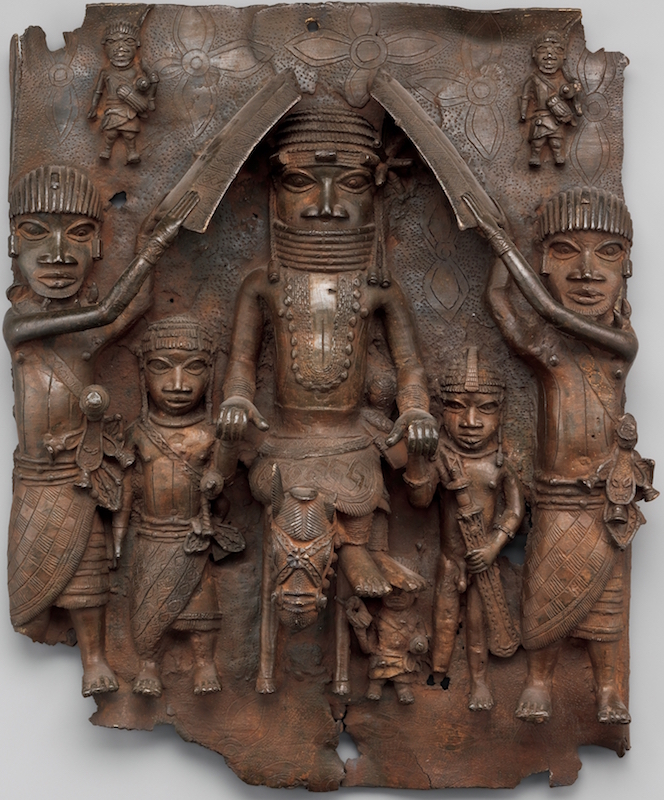
Benin Plaque showing the Façade of the Royal Palace by Unknown (Benin)
Benin Plaque showing the Façade of the Royal Palace, Unknown Edo artist, c. 1550–1650, brass, Kingdom of Benin (modern-day Nigeria), British Museum, London

Overview

About This Work

The Benin Plaque showing the Façade of the Royal Palace (c. 1550–1650) is one of the most structurally complex and historically significant artworks from the Kingdom of Benin (modern-day Nigeria). Cast in brass (often colloquially called "bronze") using the lost-wax technique, this high-relief plaque is housed in the British Museum (Af1898,0115.46) and the Ethnologisches Museum, Berlin (a similar variant). Unlike most plaques which depict solitary figures or pairs of courtiers, this work offers a rare architectural representation of the Oba's palace itself. It serves as a visual document of the palace's appearance before its destruction by British forces during the Punitive Expedition of 1897. The plaque functioned as both decoration and historical record, mounted on the wooden pillars of the palace courtyards to impress visitors with the wealth, stability, and divine power of the Oba (king).

Visual Analysis

Composition

The Palace Structure: The plaque depicts a section of the royal palace, specifically a gateway or veranda. It features a shingled roof supported by pillars. Crucially, the pillars in the depiction are themselves covered with rectangular plaques—a "meta" moment where the art depicts itself in situ, confirming how these artworks were displayed. The Turret and Python: Dominating the upper section is a central turret or tower surmounted by a massive python. The snake slithers vertically down the roof, its head hovering menacingly over the entrance. This is the Python of Olokun (god of the sea/wealth), symbolizing the Oba's connection to the spiritual realm and his power to punish wrongdoers. The Ibis Bird: Perched atop the roof is a long-legged bird, often identified as an ibis or a "bird of prophecy" (ahianmwen-oro). In Benin mythology, an ibis once predicted disaster for Oba Esigie; he killed it, proving his triumph over fate. Its presence on the roof symbolizes the Oba's conquest of destiny. Figures and Hierarchy: The scene includes four figures arranged hierarchically. Two Central Guards flank the doorway—large, armed guards or high-ranking courtiers holding shields and spears/staffs. Their size (larger than the others) indicates their high status. Two Attendants (depicted smaller to show lower status) are sometimes interpreted as pages or servants. The figures wear elaborate coral bead collars, anklets, and headdresses. In Benin culture, coral belongs to the Oba (who controls trade with the Portuguese/sea) and is a marker of immense privilege.

Colour & Light

River Leaf Pattern: The background is filled with a textured quatrefoil or "river leaf" motif (ebe-ame). This pattern is ubiquitous in Benin art and is associated with Olokun and the river, reinforcing the kingdom's source of wealth (trade and spiritual power). Leopards: At the feet of the figures or on the depicted plaques, leopards may be visible. The leopard is the "king of the bush" just as the Oba is "king of the home." The Oba kept semi-tame leopards in the palace, and the animal symbolizes his ability to take life and his restless, dangerous power. The brass itself has a warm, golden-brown patina that would have originally been more reddish-gold and shiny, symbolizing the Oba's permanence and divinity (the "Red God").

Materials & Technique

Lost-Wax Casting: The plaque is a masterpiece of technical skill. The artist modeled the scene in wax over a clay core, covered it in clay, melted the wax out, and poured in molten brass. The high relief (some limbs are almost fully three-dimensional) required exceptional mastery to prevent the mould from collapsing. Brass/Bronze: The metal itself is significant. Brass was a shiny, reddish-gold material that did not rust, symbolizing the Oba's permanence and divinity. The metal was acquired through trade with Europeans (manillas melted down), making the material itself a symbol of the Oba's control over international commerce.

Historical Context

Context

The Golden Age of Benin (16th–17th Century): This period corresponds to the reigns of warrior kings like Oba Esigie and Oba Orhogbua. The kingdom was expanding militarily and profiting from trade with the Portuguese (and later Dutch/British). The influx of brass from Europe allowed for a flowering of artistic production, leading to the creation of hundreds of these plaques to decorate the expanded palace. The Palace as Center: The palace was a city within a city—a labyrinth of courtyards, shrines, and quarters for the Oba's wives and guilds. It was the spiritual and political heart of the Edo people. European visitors (like Olfert Dapper in 1668) wrote awestruck descriptions of its size and the "copper" birds on its roof, which this plaque visually corroborates. 1897 Punitive Expedition: The palace was looted and burned by British troops in 1897 in retaliation for an ambush. Thousands of artworks (the "Benin Bronzes") were seized as "reparations" to pay for the expedition and scattered to Western museums. This specific plaque is thus a survivor of colonial violence—a depiction of a building that was destroyed by the very people who collected the image of it.

Key Themes

Power and Protection

The Oba's Liminality: The Oba exists between worlds: between land and sea (Olokun), between human and animal (leopard), and between the living and ancestors. The architectural symbols (python, bird) mark the palace as a liminal space—a threshold where these worlds meet. Surveillance and Authority: The python looking down from the roof serves as a "policeman," watching those who enter. It visualizes the idea that the Oba sees everything and that justice is swift. Architecture as Power: The plaque proves that pre-colonial African architecture was monumental and sophisticated. It challenges the colonial myth that African societies lacked "civilization" (often defined by permanent architecture). The depiction of shingles, columns, and decoration evidences a complex urban culture.

Exam Focus Points

Critical Perspectives

Restitution Debate: This artwork is central to the current global debate on restitution. Nigeria has formally requested the return of the Benin Bronzes. Arguments for return focus on the violent circumstances of their removal (theft/looting). Arguments for retention (by Western museums) often cited "preservation," though this is increasingly rejected as colonial paternalism. "Meta" Art: Discuss the self-referentiality of the plaque. It is a plaque showing pillars that are covered in plaques. This proves that the plaques were not just stored away but were integral to the architectural experience of the palace. It provides the "instruction manual" for how to display the collection. Narrative vs. Iconic: Unlike European art which often tells a linear story, Benin art is iconic and symbolic. The figures do not interact in a "scene" (e.g., talking to each other); they stand frontally, presenting their status to the viewer. The arrangement is static and eternal, not fleeting or narrative.

On this page

OverviewVisual AnalysisHistorical ContextKey ThemesExam Focus Points