History of (tagg)Art...
HomeNatureIdentityRenaissanceBaroque

Nature

  • All Nature artworks
  • Landscape or Seascape in 2D
  • Animals in 2D or 3D
  • The Elements (Fire, Water, Wind or Earth) in 2D or 3D
  • +3 more topics

Identity

  • All Identity artworks
  • The Divine in 2D or 3D Works
  • Portraits in 2D Works
  • Portraits in 3D Works
  • +3 more topics

Renaissance

  • All Renaissance artworks
  • Religious Painting
  • Religious Sculpture
  • Mythological in 2D or 3D
  • +3 more topics

Baroque

  • All Baroque artworks
  • Religious Painting
  • Religious Sculpture
  • Mythological Painting
  • +6 more topics

About

A comprehensive study resource for Pearson Edexcel History of Art A-Level.

NatureIdentityRenaissanceBaroque

History of (tagg)Art... - A-Level Study Resource

Pearson Edexcel Specification

Admin
  1. Home
  2. Baroque
  3. The Rape of Proserpina

The Rape of Proserpina

Gianlorenzo Bernini, 1621-1622
BaroqueMythological SculptureItalian Artists
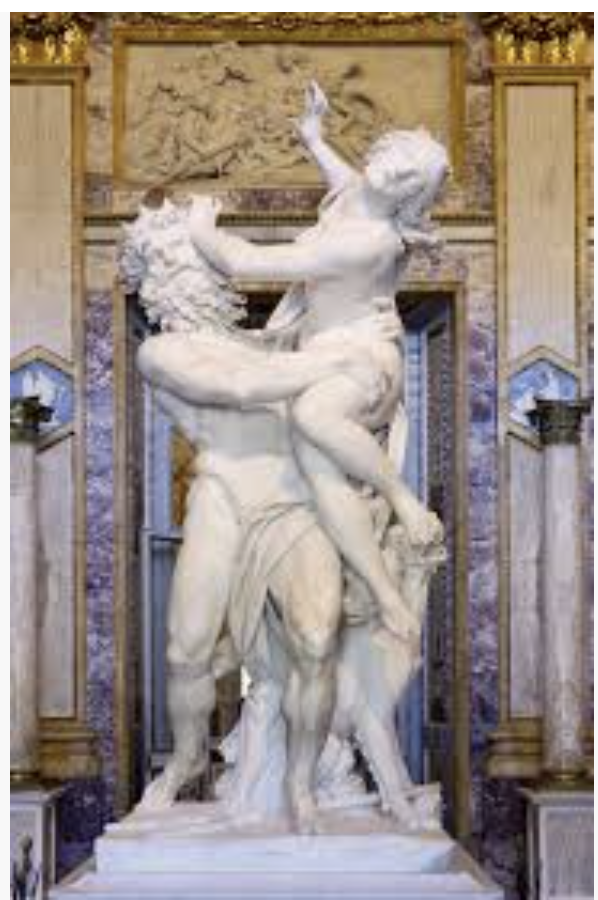
The Rape of Proserpina by Gianlorenzo Bernini
Gian Lorenzo Bernini, The Rape of Proserpina, 1621–1622, Carrara marble, 225 cm, Galleria Borghese, Rome

Overview

About This Work

The Rape of Proserpina is the second of the four great mythological marble groups that Bernini produced for Cardinal Scipione Borghese between 1618 and 1625, and is widely regarded as the foundational monument of Baroque sculpture. Commissioned in 1621 and completed in 1622 — when Bernini was just twenty-three years old — it depicts the climax of the myth narrated by both Ovid in the Metamorphoses and Claudian in De raptu Proserpinae: the moment at which Pluto, god of the underworld, seizes and carries off Proserpina (Persephone), daughter of Ceres (Demeter), from the shores of Lake Pergusa in Sicily. Shortly after completion, Scipione Borghese presented the statue to Cardinal Ludovico Ludovisi, and it subsequently passed through several collections before being acquired by the Italian state and returned to the Villa Borghese in 1908. It remains there today.

Visual Analysis

Composition

The Decisive Moment: Bernini does not represent the narrative before or after the abduction — he seizes, with characteristic precision, the instant of maximal dramatic tension: the exact moment at which Pluto's grip closes on Proserpina and she realises she cannot escape. Proserpina has reacted with her entire body — her torso twists away, she pushes against Pluto's chest with one hand while raising the other in appeal, her face contorted in anguish. The three-headed dog Cerberus crouches at Pluto's feet, one head facing forward, the others turned to check the flanks — guardian of the underworld ensuring no rescue can come. Unlike the Mannerist figura serpentinata of Giambologna's Rape of the Sabine Women (1574–1582) — which was explicitly conceived for viewing from multiple angles — Bernini organises his group around a single, privileged frontal viewpoint. Viewed head-on, the composition presents both protagonists' faces simultaneously — Pluto's grim determination and Proserpina's open-mouthed anguish — while the full drama of their struggling bodies reads with maximum compositional clarity. This return to a privileged viewpoint — departing from Mannerist multi-viewpoint dispersal — represents one of Bernini's most significant formal innovations, reasserting the classical principle of compositional unity.

Colour & Light

The Fingers in the Flesh: The most celebrated detail in the entire work — and one of the most discussed details in all of Western sculpture — is the sight of Pluto's fingers sinking visibly into the marble of Proserpina's thigh. Bernini "prided himself on being able to give marble the appearance of flesh," and nowhere is this achievement more startlingly demonstrated. The stone yields, indents, and compresses beneath the grip — the material contradiction of cold marble behaving as soft skin is physically shocking. This technical paradox — hard material rendered as soft — is not merely virtuosity for its own sake. It enacts the sculpture's central narrative argument: Pluto's stone-hard power compressing the vulnerable organic body of the girl. The contrast between Pluto's muscular, taut anatomy (deeply carved, with abdominals, lats, and forearm tendons sharply defined beneath the effort of his grip) and Proserpina's yielding, soft-modelled flesh is the physical embodiment of the power relationship the myth narrates. Proserpina's face — thrown back, mouth open in a cry, tears actually carved on her cheeks — is among the most technically audacious in all of marble sculpture. Her expression does not merely register distress but precisely calibrates the psychological state of a person experiencing violent, unexpected assault — the terror, the disbelief, the physical shock.

Materials & Technique

The entire group is carved from a single block of Carrara marble — the same high-quality material from Tuscany used by ancient Roman sculptors and by Michelangelo. Carrara marble's fineness of grain permits the kind of minute surface differentiation — between taut muscle and compressed flesh, between the smooth skin of youth and the rougher texture of Cerberus's fur — that Bernini exploited throughout his career. The marble was worked with a graduated sequence of tools: point chisel for rough blocking, toothed chisel for intermediate modelling, flat chisel and rasp for refinement, and finally drill and abrasive to create the polished, skin-like surfaces and the deep shadow-catching hollows of the hair. The virtuosity of the drilling — the deep, shadow-filled curls of Pluto's hair and beard, the individual strands of Proserpina's blown-back hair, the three heads of Cerberus — demonstrates the technical extremity that Bernini demanded of the marble. The formal challenge of representing flowing, wind-disturbed hair in static stone was the same challenge confronted by Hellenistic sculptors in the Laocoön; Bernini not only meets it but extends it to unprecedented complexity.

Historical Context

Context

The Rape of Proserpina was commissioned by Cardinal Scipione Borghese, one of Rome's most powerful ecclesiastics and most discriminating collectors, as a virtuosic demonstration of his collecting ambition and taste — the Borghese groups were conceived as a coherent program of mythological subjects from ancient Latin literature (Virgil and Ovid) intended to display the full range of sculptural achievement possible within a single patronage relationship. However, a secondary allegorical layer has been identified by scholars. The myth of Pluto and Proserpina — whose agreement to share Proserpina between the underworld and the upper world for six months each year explains the cycle of seasons — carried allegorical reference to regeneration and dynastic continuity. Scholar Winner has argued this connects to the imminent marriage of Marcantonio II Borghese and Camilla Orsini and the anticipated birth of an heir (born 1624) — making the sculpture a coded statement of Borghese family continuity and generational renewal. The most direct sculptural precedent for the Rape of Proserpina is the Laocoön (c. 1st century BC, Musei Vaticani) — which Bernini had studied intensively in the Vatican collections. The Laocoön had demonstrated the representation of extreme physical suffering and violent struggle in multi-figure composition, with bodies intertwined in violent dynamic engagement and faces expressing specific emotional agony. Pluto's wide-legged stance, his twisting torso, and his facial expression of concentrated power all engage with the Laocoön's visual vocabulary.

Key Themes

Connection to Baroque

Exam Focus Points

Critical Perspectives

Rudolf Wittkower observed that "representations of such rape scenes depended on Bernini's new, dynamic conception for the next hundred and fifty years," recognizing that Bernini fundamentally transformed how sculptors represented violent, dramatic narratives. Howard Hibbard notes the "texture of the skin, the flying ropes of hair, the tears of Persephone and above all the yielding flesh of the girl" — observing how Bernini achieves what painting accomplishes through colour through the play of light on carved marble surfaces. Compared with Giambologna's Abduction of a Sabine Woman (1574–1582), Bernini's work is more psychologically intense and emotionally explicit. Where Giambologna maintains classical restraint, Bernini immerses the viewer in terror and struggle, marking the transition from Mannerism to Baroque. The sculpture's revolutionary status lies in its dual achievement: it is simultaneously a technical tour de force of marble carving and a profound meditation on violence, vulnerability, power, and the human body rendered in eternal stone.

On this page

OverviewVisual AnalysisHistorical ContextKey ThemesExam Focus Points