History of (tagg)Art...
HomeNatureIdentityRenaissanceBaroque

Nature

  • All Nature artworks
  • Landscape or Seascape in 2D
  • Animals in 2D or 3D
  • The Elements (Fire, Water, Wind or Earth) in 2D or 3D
  • +3 more topics

Identity

  • All Identity artworks
  • The Divine in 2D or 3D Works
  • Portraits in 2D Works
  • Portraits in 3D Works
  • +3 more topics

Renaissance

  • All Renaissance artworks
  • Religious Painting
  • Religious Sculpture
  • Mythological in 2D or 3D
  • +3 more topics

Baroque

  • All Baroque artworks
  • Religious Painting
  • Religious Sculpture
  • Mythological Painting
  • +6 more topics

About

A comprehensive study resource for Pearson Edexcel History of Art A-Level.

NatureIdentityRenaissanceBaroque

History of (tagg)Art... - A-Level Study Resource

Pearson Edexcel Specification

Admin
  1. Home
  2. Baroque
  3. Apollo and Daphne

Apollo and Daphne

Gianlorenzo Bernini, 1622-1625
BaroqueMythological SculptureItalian Artists
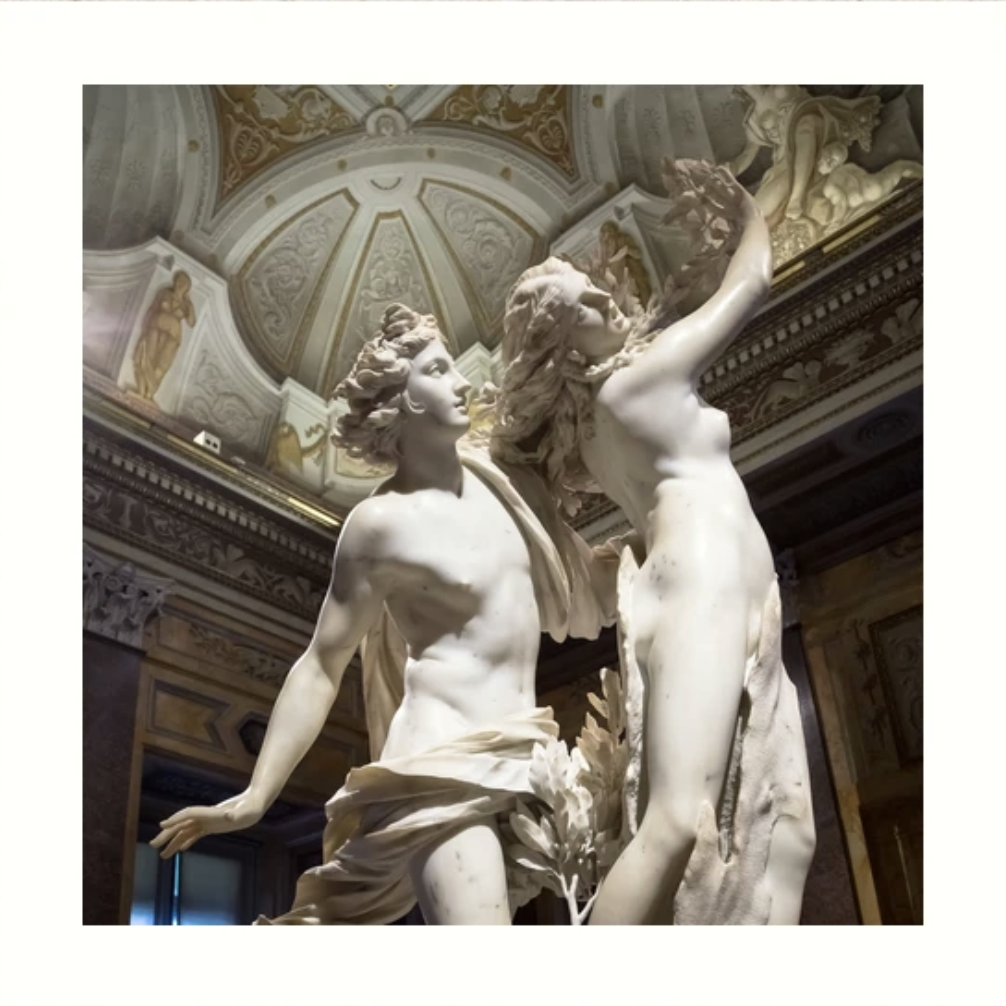
Apollo and Daphne by Gianlorenzo Bernini
Bernini, Apollo and Daphne, 1622–1625, Carrara marble, 243 cm height, Galleria Borghese, Rome

Overview

About This Work

Apollo and Daphne is the third and formally most ambitious of the Borghese marble groups, begun immediately after the Rape of Proserpina and completed in 1625. It depicts the climactic moment of the Ovidian myth in which the nymph Daphne, fleeing Apollo's pursuit, is transformed into a laurel tree by her father Peneus just as Apollo's hand touches her. Bernini selects the instant of maximum metamorphic tension: Daphne's feet have become roots, her fingers elongate into branches, bark creeps up her calves, while her torso remains human flesh. Apollo has just touched her and feels the transformation beginning. The sculpture is widely considered the supreme technical achievement of Baroque marble sculpture. Key facts: • Depicts the moment of metamorphosis in progress, not as a completed state • Assisted by Giuliano Finelli, who carved the extraordinary laurel-leaf detail • Gossamer-thin marble leaves are carved to the limit of marble's material tolerance • Modelled on the Apollo Belvedere (classical Greek original in the Vatican) • Original base carries a Latin distich by Cardinal Maffeo Barberini (later Pope Urban VIII)

Visual Analysis

Composition

The compositional innovation of Apollo and Daphne is the representation of transformation as a process in progress rather than as a completed state. Bernini requires the viewer to hold two temporal states simultaneously: Daphne as she was (a living human figure) and Daphne as she is becoming (a rooted tree). This temporal layering within a single static form is Bernini's most radical sculptural innovation—more challenging technically than any previous marble group because it requires the convincing simultaneous representation of three distinct material states (flesh, bark, and leaf) within a single continuous carved surface. The composition builds vertically: the feet are already roots, the calves crusted with bark, the hips and torso remain human flesh, the raised arms become branches, the fingers already leaves. The spiral composition forces the viewer to move around the group to comprehend the full narrative—from the front, Apollo's pursuit is dominant; from the side, Daphne's transformation becomes visible; from behind, the bark spreading up her back completes the metamorphosis.

Colour & Light

The white Carrara marble becomes a vehicle for representing multiple material transformations. The polish and finish vary across the surface: the flesh areas are smoothly finished to suggest skin's tactile quality, the bark is rougher and more textured, and the leaves are carved to such thinness that light passes through them with a translucency approaching actual foliage. This differential finish allows the marble itself to communicate the magical metamorphosis. The original spatial placement—with the sculpture's back to the wall—meant visitors first saw Daphne's back in flight, with the full transformation revealed only by moving around the group. The changing angle of light as viewers circumambulate the work emphasizes the dynamism of the transformation. Bernini manipulates surface texture to catch and release light differently across the work, creating an optical shimmer that reinforces the sense of ongoing change.

Materials & Technique

The gossamer-thin marble laurel leaves—some barely a millimetre in thickness, trembling apparently from Daphne's rapid movement—were carved primarily by Finelli under Bernini's direction. They represent the most extreme technical challenge in the work: marble carved to the limit of its material tolerance. Leaves so thin that light passes through them with translucency approximate the actual quality of foliage. The drilling required to separate individual leaves without fracturing adjacent ones demanded extraordinary precision; occasional visible restoration indicates where breakage occurred. Apollo's body and pose derive directly from the Apollo Belvedere, the ancient sculpture that remained the supreme classical model for the idealised male body. The reference is deliberate and legible to educated viewers: Bernini was claiming that his Apollo surpassed the classical original by adding dynamism, psychological depth, and narrative specificity that ancient sculpture never attempted.

Historical Context

Context

Apollo and Daphne was created during the height of Bernini's career, when he had become the preeminent sculptor of the papal court and the Counter-Reformation elite. The work was commissioned as part of the sculptural decoration of the Casino Borghese (the villa's pleasure pavilion, now the Galleria Borghese), where it has remained continuously since its creation. The addition of Cardinal Maffeo Barberini's Latin distich to the base provided moral justification for displaying such a sensuous mythological subject in a clerical household, reframing the work as a moralitas—a moral allegory warning against the pursuit of worldly pleasure. The inscription reads: "Those who love to pursue fleeting forms of pleasure, in the end find only leaves and bitter berries in their hands." This inscription reflects the profound tension within Counter-Reformation culture between the celebration of beauty as a vehicle for spiritual ascent (Neoplatonism) and suspicion of sensory pleasure as distraction from spiritual duty. The irony is intentional: the moralizing text cannot suppress the overwhelming sensuous beauty of the sculpture itself.

Key Themes

Metamorphosis, Desire, and Material Virtuosity

Metamorphosis and Transformation: The work's central innovation is representing transformation as process rather than completion, requiring simultaneous perception of multiple temporal and material states. Bernini captures the precise instant when Daphne is neither fully human nor fully tree—a liminal moment that had never been successfully rendered in sculpture before. Male Desire and Female Evasion: The sculpture visualizes the myth's central tension: Apollo's frustrated desire as Daphne escapes into another form. Even in transformation, her body continues to evade the male gaze. Art historian Andrea Bolland argues that the trajectory of the leaves and branches pointing toward Apollo's groin represents Bernini's visual commentary on sexual frustration at the myth's heart. Material Virtuosity and Illusion: The work demonstrates marble's capacity to represent multiple material states—flesh, bark, and leaf—creating an optical illusion of actual transformation within static stone. The gossamer-thin foliage carved by Giuliano Finelli represents the absolute limit of marble's material tolerance. Classical Reference and Baroque Innovation: Bernini deliberately references the Apollo Belvedere to claim that modern sculpture surpasses antiquity through psychological depth and narrative specificity. Where the classical Apollo is static and idealized, Bernini's Apollo is caught in passionate pursuit, his face registering the dawning horror of Daphne's transformation. Morality and Sensuality: The Barberini inscription's condemnation of worldly beauty creates ironic tension with the sculpture's extraordinary sensuous appeal, reflecting Counter-Reformation cultural anxieties about the relationship between aesthetic pleasure and spiritual virtue.

Exam Focus Points

Critical Perspectives

Critical Perspectives: Andrea Bolland argues that the trajectory of the leaves and branches pointing toward Apollo's groin represents Bernini's visual commentary on sexual frustration at the myth's heart, with Daphne's body continuing to evade desire even in transformation. Art historical tradition considers Apollo and Daphne the supreme technical achievement of Baroque marble sculpture, representing the zenith of marble-carving virtuosity through the gossamer-thin foliage and simultaneous representation of multiple material states. The religious interpretation reframes the sensuously beautiful Daphne as an allegory for virtue fleeing passion, the laurel as symbol of eternal purity, creating intentional tension between visual pleasure and moral message through Cardinal Barberini's inscription. Key Exam Points: Technical Innovation: Understand how Bernini represents metamorphosis as process rather than completed state—the simultaneous representation of flesh, bark, and leaf within continuous carved surface. Classical Sources: Be able to discuss the relationship to the Apollo Belvedere and how Bernini claims to surpass antiquity through psychological depth and narrative specificity. Collaborative Practice: Note the role of Giuliano Finelli in carving the extraordinary laurel-leaf detail, representing the collaborative nature of Baroque sculpture workshops. Patronage Context: Understand the Borghese commission and how the moral inscription attempts to justify displaying sensuous mythological content in a clerical household. Viewing Experience: Consider how the original placement against a wall created a sequential revelation as viewers moved around the sculpture, with the full transformation only visible from certain angles.

On this page

OverviewVisual AnalysisHistorical ContextKey ThemesExam Focus Points