The Renaissance in Italy
1420–1520
Invention and Illusion: A comprehensive context analysis covering art historical terms, cultural and political factors, materials and techniques, and critical interpretation.
Part 1
Art Historical Terms and Concepts
Terminology for 2D Works (Painting and Drawing)
Composition & Perspective
Composition refers to the organization and arrangement of visual elements within the picture plane. Renaissance painters moved decisively away from the flat, hierarchical arrangements of medieval art toward rational, geometrically structured compositions grounded in mathematical laws.
A central compositional innovation was single-point linear perspective (prospettiva artificiale), invented by Filippo Brunelleschi (c. 1415) and theorized by Leon Battista Alberti in De pictura (1435). This system creates the illusion of three-dimensional depth on a flat surface by establishing a single vanishing point toward which all parallel lines converge; objects diminish in scale proportionally as they recede.
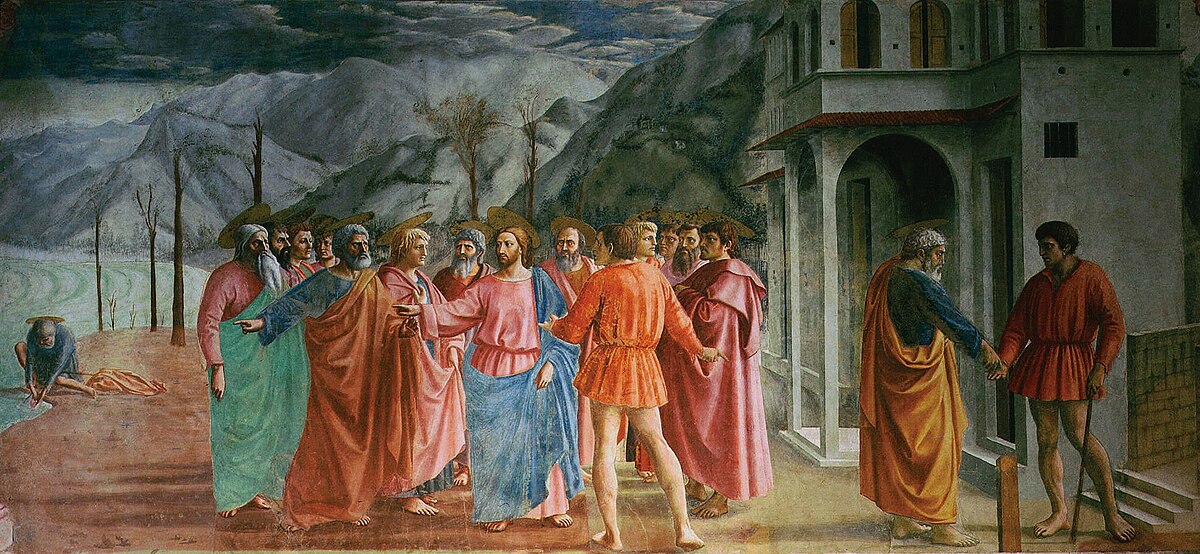
Example: Linear Perspective
Masaccio, Tribute Money, c.1425
Light and Shadow Techniques
Chiaroscuro (Italian: chiaro = light, scuro = dark) refers to the use of contrasting light and shadow to model three-dimensional form. By representing the graduation from light to shadow across a surface, painters could convincingly suggest volume and mass rather than relying on outline alone.
Sfumato (Italian: sfumare = to evaporate or soften) is a specific chiaroscuro technique—associated primarily with Leonardo da Vinci—employing extraordinarily subtle tonal transitions so gradual that no hard outline is detectable. The effect creates an atmospheric softness, particularly around facial features, conveying psychological depth and animation.
Foreshortening describes the representation of a figure or object in perspective so that it appears compressed in length as it recedes from the viewer. Renaissance painters developed foreshortening as a demonstration of disegno and anatomical mastery. Andrea Mantegna's Dead Christ (c. 1480) demonstrates extreme foreshortening with Christ's body viewed from foot to head.
Preparatory Techniques
Cartoon (Italian: cartone) denotes a full-scale preparatory drawing used in transferring a composition onto a fresco wall or panel. Major cartoons by Raphael (for the Vatican Stanze) and Michelangelo survive as independent artistic achievements.
Sinopia refers to the preparatory drawing executed in red ochre on the arriccio (rough plaster) layer beneath a fresco's final intonaco (smooth plaster) layer. When later restorations detached Renaissance frescoes, sinopie (plural) were revealed and became significant documents of artistic process.
Figure Representation
Contrapposto—though primarily a sculptural term—extends to two-dimensional representation: figures rendered with the same spiralling, weight-shifted pose that creates visual dynamism in three dimensions. Raphael's figures in the Vatican Stanze frequently employ painted contrapposto, demonstrating both classical inheritance and mastery of human anatomy.
Picture plane denotes the imaginary flat surface of a painting through which the viewer appears to look into illusionistic space. Alberti famously described the picture as "an open window through which I see what I want to portray"—a metaphor that defines the entire Renaissance approach to pictorial representation.
Altarpiece Formats
Triptych / altarpiece / predella: standard formats for Renaissance devotional painting. A triptych has a central panel flanked by two wings; the predella is the horizontal strip of smaller narrative panels forming the base of an altarpiece.
Sacra conversazione (holy conversation): a devotional image format depicting the Virgin and Child with saints arranged in casual, naturalistic communication rather than the hierarchically rigid configurations of Byzantine and Gothic precedent. The format emphasized the humanity and approachability of sacred figures, reflecting Humanist concerns.
Terminology for 3D Works (Sculpture)
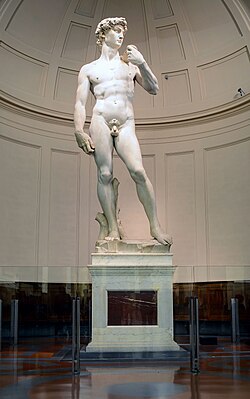
Relief sculpture involves figures carved or modelled so that they project from a flat background surface. Renaissance sculptors distinguished between alto rilievo (high relief), mezzo rilievo (medium relief), and basso rilievo or schiacciato (very low relief—literally "squashed flat").
Donatello invented schiacciato, a technique in which figures barely project from the surface yet achieve startling illusionistic depth through extremely subtle modelling and the application of perspectival principles. His Feast of Herod panel from the baptismal font in Siena Cathedral (c. 1427) demonstrates schiacciato at its most refined.
Contrapposto (Italian: counterpose): the classical Greek innovation (revived by Renaissance sculptors) of distributing figure weight so that it rests on one leg, allowing the hips and shoulders to tilt in complementary directions and producing a subtle spiral movement through the torso. Contrapposto replaces the rigid frontality of Egyptian or archaic Greek sculpture with organic, natural-seeming weight distribution.
Free-standing sculpture / sculpture in the round: sculpture that can be viewed from all sides and is not attached to an architectural support. The revival of monumental free-standing sculpture—abandoned after antiquity—was one of the Renaissance's most dramatic departures from medieval practice. Donatello's David is the period's earliest surviving example.
Lost-wax casting (cire-perdue): the ancient bronze-casting technique revived by Renaissance sculptors. A wax model is encased in clay; when heated, the wax melts away ("lost"), leaving a mould into which molten bronze is poured. The technique permitted the casting of complex forms with thin walls.
Polychrome sculpture: sculpture painted or finished in multiple colours. Italian Renaissance sculptors tended toward monochrome marble or patinated bronze—connecting the work to classical antiquity—while polychromed terracotta works by the della Robbia family remained important for devotional accessibility.
Tabernacle: an architectural niche housing a sculptural figure on the exterior of a building or on an interior pier. Orsanmichele in Florence displays Renaissance tabernacles by Donatello, Ghiberti, and Verrocchio, providing a canonical sequence demonstrating the development of Renaissance sculpture.
Terminology for Architecture
The Classical Orders
Orders: the system of architectural design derived from ancient Greek and Roman practice, in which columns, entablatures, and proportional systems are organized into five canonical types:
- Doric (simplest, with plain capital) — considered masculine and austere
- Ionic (with volute capitals) — refined and scholarly
- Corinthian (with acanthus-leaf capital) — elaborate and feminine
- Tuscan (a simplified Roman version of Doric)
- Composite (combining Ionic and Corinthian)
Renaissance architects such as Brunelleschi (for the Ospedale degli Innocenti, 1419) and Alberti (for Santa Maria Novella's façade, c. 1470) revived the orders as organizing systems while adapting them to contemporary ecclesiastical and civic programs.
Architectural Elements
Pilaster: a flattened column embedded in or projecting slightly from a wall surface, decorative rather than structurally functional, providing the rhythm and proportion of the orders while remaining essentially planar.
Arcade and colonnade: a series of arches supported by columns (arcade) or of columns supporting a horizontal entablature (colonnade). Brunelleschi's Ospedale degli Innocenti (begun 1419) employs a continuous arcade of semi-circular arches on Corinthian columns—a composition that became paradigmatic for Florentine Renaissance architecture.
Nave, transept, crossing, apse: the primary spatial components of a basilican church plan. The nave is the central longitudinal hall; the transept is the transverse arm creating a cross plan; the crossing is the spatial zone where nave and transept intersect, often surmounted by a dome; the apse is the semicircular termination of the nave.
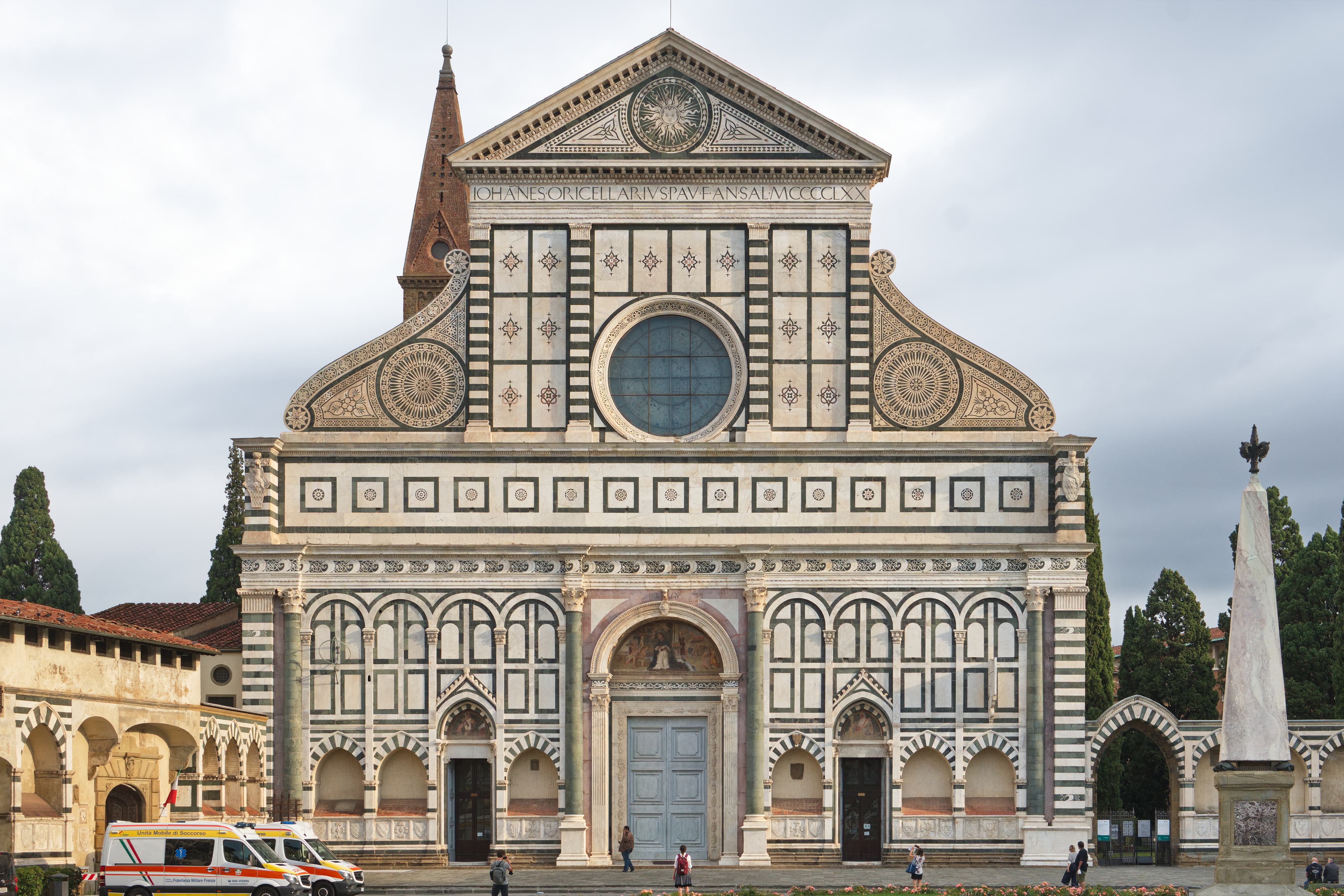
Example: Classical Orders in Architecture
Alberti, Santa Maria Novella façade, c.1470
Dome Construction
Drum and dome: the drum is the cylindrical or polygonal base upon which a dome rests; by raising the dome on a drum, the structure becomes more visible from the exterior and the interior space gains height and light. Brunelleschi's dome for Florence Cathedral (1420–1436), built without centering through a double-shell construction method, represents the period's supreme architectural-engineering achievement.
Pendentive and squinch: the means by which a circular dome is supported on a square crossing. Pendentives are spherical triangular surfaces filling the corners between the square arches and the circular dome base; squinches are small arches or niches across the angles of a square space.
Palace Architecture
Piano nobile: literally "noble floor"—the principal reception floor of a Renaissance palazzo, raised above a ground-level rusticated base to distinguish it from service and commercial functions below.
Rustication: the treatment of stonework with rough-textured, projecting blocks separated by deep joints, creating an impression of massive strength and civic authority. Michelozzo's Palazzo Medici-Riccardi (begun 1444) employs graduated rustication—rough at the base, smoother at the piano nobile—suggesting a visual metaphor for controlled power.
Oculus: a circular opening at the apex of a dome or elsewhere in a wall, providing light and often serving as a spiritual metaphor (the eye of God).
Trompe l'oeil: (French: "deceives the eye") illusionistic architectural painting that creates the impression of three-dimensional architectural space on a flat or curved surface. Mantegna's Camera degli Sposi ceiling (Palazzo Ducale, Mantua, 1465–74) employs trompe l'oeil to paint an illusionistic oculus.
Formal Elements and Their Effects on Meaning
Line
The hard, precise outlines characteristic of Florentine painting (derived from disegno) create clarity of form and assert intellectual control. Botticelli's Birth of Venus employs lyrical, curving outlines that create calligraphic elegance. By contrast, Venetian painting increasingly subordinates line to colour and tone.
Colour
Colour serves theological, hierarchical, and emotional functions. Deep lapis lazuli blue for the Virgin's mantle remained a sign of her supreme status. In Venice, the development of oil paint permitted increasingly nuanced, glowing colour effects—what critics termed colorito—that became Venice's defining aesthetic.
Tone and Light
Masaccio's Tribute Money demonstrates revolutionary tonal consistency: a single light source illuminates all figures from the same direction. This tonal coherence—as opposed to the multiple, inconsistent light sources of earlier painting—creates spatial unity and psychological realism.
Proportion and Scale
Mathematical proportion derived from Vitruvius established ideal ratios between architectural elements based on the proportions of the ideal human body. Brunelleschi's buildings employ proportional systems in which each dimension relates to the others through simple numerical ratios (1:2, 1:3, 2:3).
Key Concepts Relevant to the Period
Genres and Subjects
Religious narrative painting (storia) occupied the highest position in the Renaissance hierarchy of subjects. Alberti in De pictura described the storia as the greatest achievement of painting: a complex narrative scene populated with multiple figures engaged in action, each expressing appropriate emotion (affetti) through gesture and facial expression.
Portrait painting achieved unprecedented status during the Renaissance as an independent genre. The classical tradition of commemorating powerful individuals was revived with philosophical backing from Humanist thought. Portraits asserted the dignity and individual worth of the subject—a radical departure from the medieval subordination of individual identity to collective religious categories.
Mythological subjects: from the mid-fifteenth century onward, Humanist patrons—particularly the Florentine Medici circle—commissioned paintings of subjects derived from ancient Greek and Roman mythology. Botticelli's Birth of Venus and Primavera represent the canonical examples.
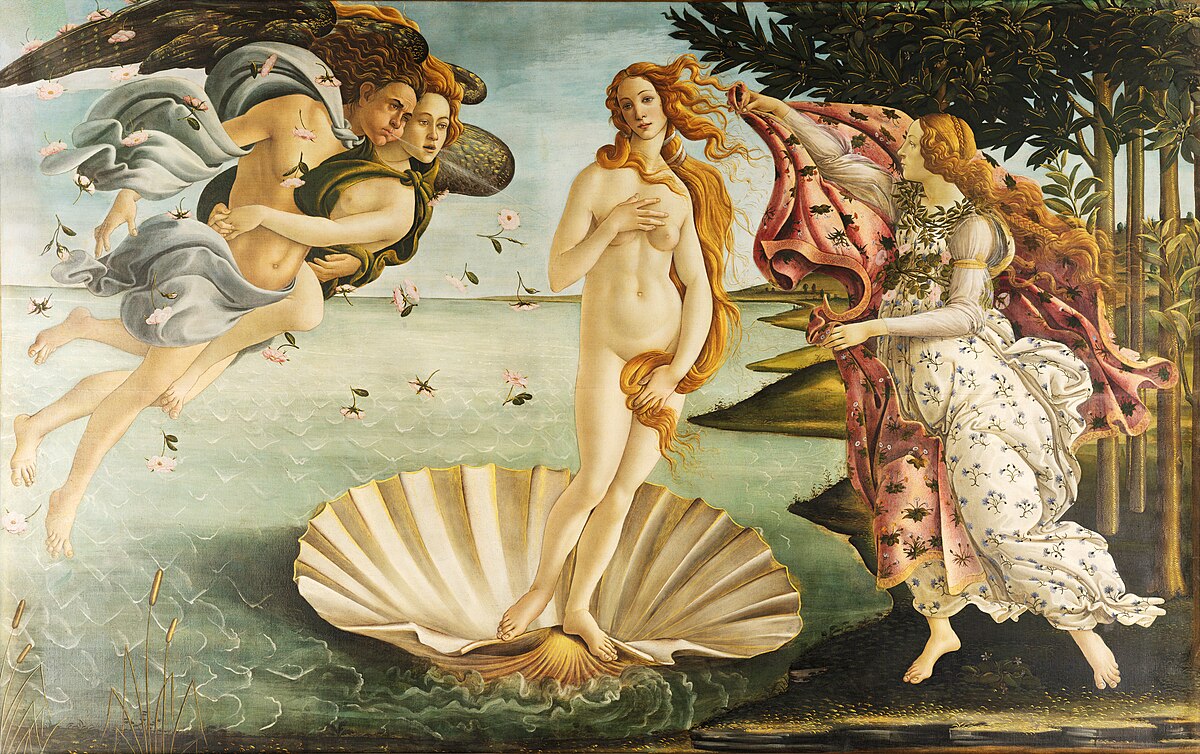
Example: Mythological Subject & Neoplatonism
Botticelli, Birth of Venus, c.1485
Classical Antiquity
The rediscovery, study, and appropriation of ancient Greek and Roman art, literature, and philosophy constituted the intellectual foundation of the Renaissance. The term "Renaissance" itself—coined by Giorgio Vasari in Le Vite (1550)—means "rebirth," explicitly referencing the revival of classical learning.
Classical sculptural models: surviving ancient sculptures—including the Laocoön (rediscovered 1506), the Apollo Belvedere, and the Marcus Aurelius equestrian bronze—provided Renaissance sculptors with formal models that differed radically from medieval conventions.
Classical architectural treatises: Vitruvius's De architectura (1st century BC, rediscovered early 15th century) provided detailed accounts of the orders, proportional systems, and engineering principles.
Idealism and Realism
Renaissance art is characterized by a complex and productive tension between idealism (representing forms according to an ideal of perfection derived from classical precedent) and realism (representing forms as they actually appear, grounded in direct observation of nature).
Raphael described his own method as composing an ideal figure from many beautiful particulars. Michelangelo's David presents an idealized human male form that represents the Neoplatonic concept of the soul's aspiration toward perfection. Meanwhile, Donatello's Zuccone portrays extreme psychological realism—the gaunt face and furrowed expression of an aged, driven visionary.
Humanism
Humanism (from Latin studia humanitatis) was the intellectual movement that placed the study of ancient Greek and Roman texts, and the cultivation of human potential and dignity, at the centre of education and cultural life.
Humanism transformed both the subjects of Renaissance art and the intellectual status of artists. Alberti's De pictura articulates the claim that painting is a noble art requiring mathematical understanding, philosophical learning, and knowledge of classical literature—not merely technical skill.
The dignity of the individual: Giovanni Pico della Mirandola's Oration on the Dignity of Man (c. 1486) argues that the human being is unique in creation—free to become whatever he chooses through reason and virtue. This provided intellectual justification for Renaissance portraiture's celebration of specific human identity.
Neoplatonism
Neoplatonism was the philosophical system developed by Marsilio Ficino at the Platonic Academy in Florence (founded c. 1462 under Medici patronage). The core concept—that the material world is an imperfect reflection of an ideal realm of eternal Forms—was adapted to argue that beauty was a manifestation of divine love, and that the human soul could ascend toward God through contemplation of earthly beauty.
Michelangelo's concept of sculpture as the liberation of the ideal form already present within the stone block—"I saw the angel in the marble and carved until I set him free"—directly expresses the Platonic distinction between the ideal form (soul) and the material world (the stone).
Disegno
Disegno (Italian: drawing or design) denotes both the physical act of drawing and the intellectual conception behind a work of art. Giorgio Vasari placed disegno at the heart of his evaluation of artistic achievement, arguing it was the "father" of the three arts (painting, sculpture, and architecture).
The debate between Florentine disegno and Venetian colorito (colour) became one of the most consequential critical debates of the Renaissance. Florentine aesthetic theory held that intellectual conception (drawn form) was superior to sensory effect (painted colour). Venetian painters argued that colour was equal or superior to line as a vehicle for artistic expression.
Artisan to Artist
The distinction between the artisan (skilled craftsman within a guild system) and the artist (creative individual expressing original intellectual conception) was a cultural transformation of fundamental importance. In medieval culture, sculptors, painters, and architects were understood as producers of skilled objects rather than creators of independent intellectual visions.
Vasari's Le Vite (1550): Giorgio Vasari's Lives of the Most Excellent Painters, Sculptors, and Architects is the foundational text for Renaissance art history and for the concept of the artist as creative genius. Vasari constructed a narrative of continuous artistic progress with Michelangelo as the supreme culmination.
Part 2
Cultural, Social, Technological and Political Factors
Political Factors
The Medici and Florentine Patronage
The Medici family—through Cosimo de' Medici (1389-1464), Lorenzo de' Medici ("the Magnificent," 1449-1492), and their successors—provided the most important private patronage of the early and high Quattrocento in Florence. Cosimo financed Donatello's mature career, commissioned the bronze David, rebuilt San Lorenzo (employing Brunelleschi), and established the Platonic Academy under Ficino's direction.
The political dimension of Medici patronage was fundamental: Cosimo and Lorenzo were not monarchs but private citizens managing a republic, and their patronage was partly a strategy for asserting authority without formal political title.
The Popes and Roman Patronage
Nicholas V (pontificate 1447-1455) initiated the systematic transformation of Rome as a papal capital and art centre.
Sixtus IV (pontificate 1471-1484) built the Sistine Chapel (1477-1481), commissioning the lateral fresco cycles from Botticelli, Perugino, Ghirlandaio, and other Florentine painters—the first systematic importation of Florentine artistic culture to Rome.
Julius II (pontificate 1503-1513)—"Il Papa Terribile"—was the most ambitious and consequential artistic patron of the period. He commissioned Bramante to rebuild St. Peter's Basilica, Michelangelo to fresco the Sistine Chapel ceiling (1508-1512), and Raphael to fresco the Vatican Stanze (from 1509).
Savonarola and the Bonfire of the Vanities
Girolamo Savonarola (1452-1498), the Dominican friar who dominated Florence between 1494 and 1498, represents a profound challenge to Renaissance artistic culture. He preached against the luxury and vanity of secular culture and organized the Falò delle Vanità (Bonfire of the Vanities, 1497), in which Florentine citizens burned mirrors, cosmetics, books, and artworks.
The Italian Wars (from 1494)
The French invasion of Italy in 1494 and the subsequent decades of Italian Wars fundamentally disrupted the political conditions that had sustained the Renaissance's golden age. The Medici were expelled from Florence in 1494; Rome was sacked in 1527 (the Sacco di Roma)—an event that scattered the High Renaissance's greatest concentration of talent throughout Europe.
Technological Factors
Linear Perspective
The development of a mathematically rigorous system for representing three-dimensional space on a two-dimensional surface was the most consequential technological achievement of the early Renaissance. Filippo Brunelleschi is credited with the invention of prospettiva artificiale around 1415. Leon Battista Alberti provided the first systematic theoretical account in De pictura (1435).
The implications were profound: it provided artists with a mathematical, rational system for achieving spatial illusion; it established the picture as a "window" onto an imagined three-dimensional world; and it provided a powerful demonstration that painting was a mathematical discipline.
The Printing Press
Johannes Gutenberg's development of movable type printing around 1450 transformed the circulation of texts and images throughout Europe. Key texts circulated rapidly and cheaply: Alberti's architectural treatise, Vitruvius's De architectura (printed 1486), and Vasari's Vite.
The dissemination of compositional ideas through printed engravings after Renaissance paintings accelerated the spread of Italian Renaissance innovations to Northern Europe.
Oil Paint
The development of oil paint technique—traditionally attributed to Jan van Eyck in the Netherlands—transformed what painters could achieve. Oil-based paints dried more slowly than tempera, allowing painters to blend colors and make corrections; they permitted a wider range of tonal gradations; they could be applied in thin, transparent glazes creating luminous colour effects; and they enabled the representation of surface textures with unprecedented specificity.
Antonello da Messina, a Sicilian painter with Flemish training, visited Venice in 1475-76 and directly introduced the technique to Venetian painters. Giovanni Bellini absorbed the method and transformed his practice, as demonstrated in the San Zaccaria Altarpiece (1505).
Influences from Other Locations and Movements
Gothic Inheritance
The Gothic tradition provided the immediate visual context from which Renaissance art departed. The persistence of Gothic conventions into the early Quattrocento is evident in works such as Gentile da Fabriano's Adoration of the Magi (1423), demonstrating that the "Renaissance" was a gradual transformation rather than a sudden rupture.
Flemish Influence
Flemish painting—particularly Jan van Eyck and Rogier van der Weyden—exerted significant influence through oil paint technique and naturalistic observation of surface detail. Hugo van der Goes's Portinari Altarpiece (c. 1475), sent to Florence around 1483, had profound impact on Florentine painters including Ghirlandaio, Botticelli, and Leonardo.
Byzantine Legacy
Byzantine art represented both the immediate tradition from which early Italian Renaissance painting evolved and an increasingly problematic model against which Renaissance artists defined their innovations. In Venice, the Byzantine legacy was particularly persistent—the Basilica di San Marco provided a visual environment of extraordinary richness that encouraged emphasis on rich surface and colour.
Florence on Rome
Sixtus IV's commission for the Sistine Chapel lateral frescoes brought Florentine painters (Botticelli, Ghirlandaio, Perugino) to Rome. Bramante arrived in Rome in 1499 and transformed Roman architecture through his knowledge of Florentine classicism. Michelangelo—trained in the Medici household—arrived in 1496.
Part 3
Materials, Techniques and Processes
2D Works: Fresco, Tempera and Oil
Fresco
True fresco (buon fresco) involves the application of pigments mixed in water onto freshly laid, still-wet lime plaster (intonaco). As the plaster dries, the pigments bond permanently with the calcium carbonate of the wall surface through a carbonation process—the colours become part of the wall itself.
Since the pigments must be applied while the plaster remains wet, the painter must work in giornate (Italian: daily working sections), completing each area before it dried—typically four to eight hours. The borders between giornate are detectable in close examination and provide crucial evidence about working sequences. Michelangelo's Sistine Chapel ceiling (1508–1512) preserves visible giornata joins that reveal his working order.
Fresco secco (dry fresco) involves applying pigments to already-dried plaster, using a binding medium such as egg or animal glue. Though easier to execute, secco painting is far less durable. Many Renaissance frescoes employed both techniques—buon fresco for primary areas, secco for costly pigments such as lapis lazuli blue (ultramarine).
The preparatory process involved three layers: the rough scratch coat (arriccio), then a preparatory drawing in red ochre (sinopia), then the final smooth plaster (intonaco). From the mid-fifteenth century, the sinopia was increasingly replaced by the cartoon system, transferred by spolvero (pouncing) or incision.
Tempera
Egg tempera (the dominant painting medium before c. 1480) involves pigments ground in water and mixed with egg yolk as a binding medium. The technique produces a matte, relatively opaque surface with crisp, hard-edged brushwork. Unlike oil paint, tempera dries almost immediately, preventing blending on the panel—modelling must be achieved through the hatched accumulation of many fine brushstrokes.
Panel preparation: tempera painting was almost exclusively executed on wooden panel, the surface prepared with multiple coats of gesso (chalk and animal glue) sanded to a smooth, brilliant white. The white gesso ground contributes significantly to the luminosity of tempera painting.
Tempera's rapid drying time creates the precise, linear qualities associated with Florentine Quattrocento painting—the sharp drapery folds, clean figure outlines, and crisp architectural details of Botticelli's altarpieces.
Oil Paint
Oil-based paint, using linseed, walnut, or poppy oil as the binding medium, dries through oxidation rather than evaporation—a much slower process that kept the paint film workable for hours or days. This fundamental difference had profound technical consequences: colours could be blended continuously; glazes (thin, transparent layers) could be built up to create luminous tonal depth; corrections could be made by wiping away or overpainting wet paint.
Venice's adoption of oil paint was rapid partly for practical reasons—the city's humidity made fresco technically problematic—and partly for aesthetic reasons—oil paint's tonal richness and atmospheric luminosity suited Venetian aesthetic priorities (colorito over disegno).
The move from panel to canvas—also pioneered in Venice—was facilitated by oil's flexibility. Canvas was cheaper and lighter than panel, could be prepared more rapidly, and permitted much larger formats.
3D Works: Bronze, Marble and Wood
Bronze
The lost-wax (cire-perdue) process: bronze casting involved first creating a detailed model in wax (built over a clay core); encasing the wax model in investment clay; heating until the wax melted and ran out; then pouring molten bronze into the void. The resulting cast was then subjected to extensive chasing—skilled surface working to sharpen details—and finally patinated.
Bronze carried powerful cultural associations derived from classical antiquity—the equestrian statues of Roman emperors, the commemorative reliefs of the Column of Trajan. Working in bronze was inherently a classicizing statement. Ghiberti's bronze doors for the Baptistery directly reference classical relief sculpture.
Bronze permitted structural configurations impossible in carved stone—extended limbs, cantilevered forms, thin elements—because it maintained integrity where marble would fracture.
Marble
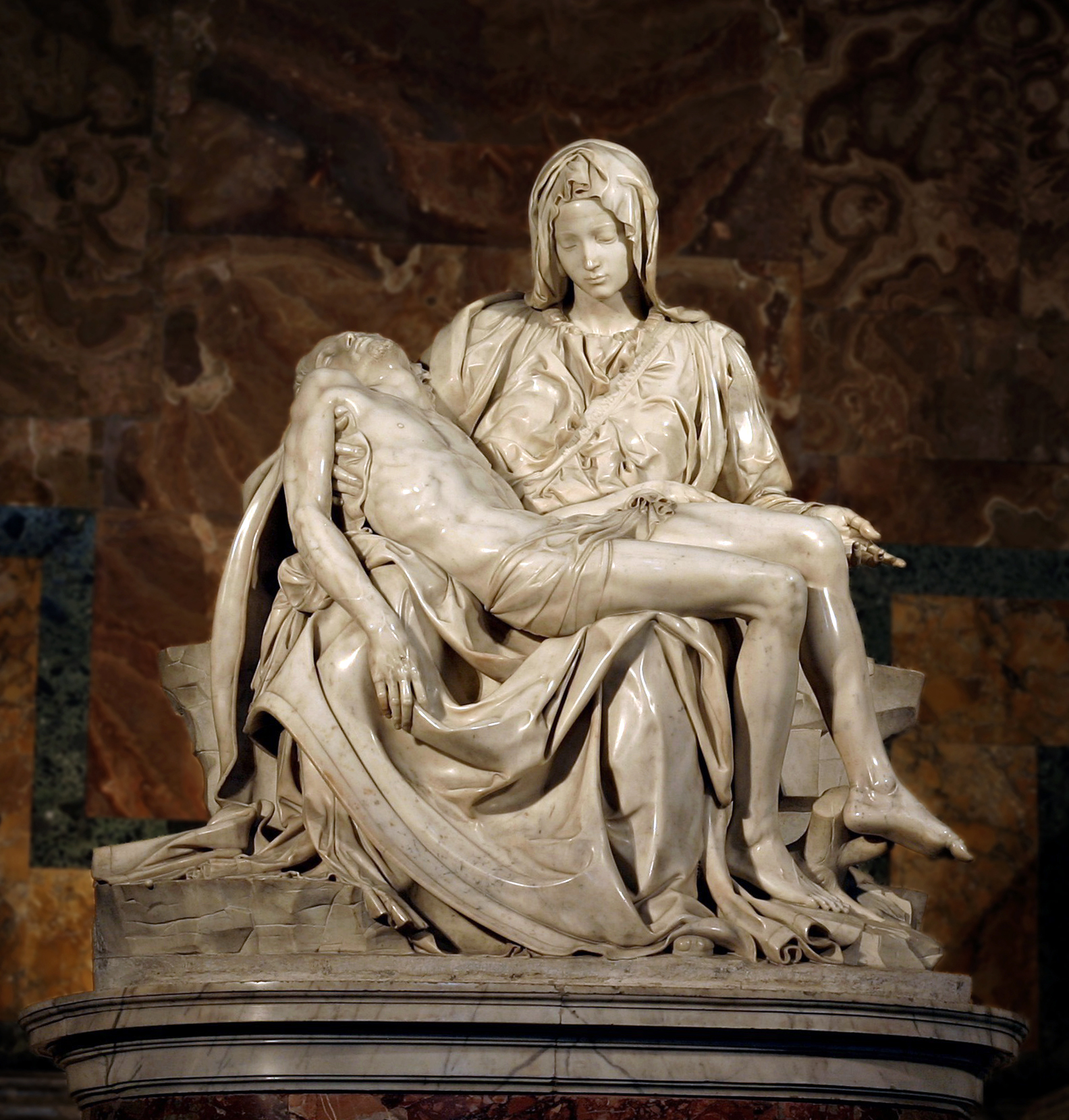
Marble carving is a fundamentally subtractive process. The primary tools were the subbia (punch, for rough removal), the gradina (toothed chisel, for intermediate working), the flat chisel (for surface refinement), and the drill (for undercuts and deep recesses). The final surface could be polished to varying degrees—high polish creating a glowing translucency.
Marble carried associations with ancient Greek and Roman sculptural achievement. For Michelangelo, marble was philosophically significant: the Neoplatonic concept of the ideal form imprisoned in matter—liberated by the sculptor's carving—was literally embodied in the working process.
The irreversibility of carving demanded exceptional confidence and advance planning. The David block had been partially worked and abandoned by earlier sculptors, leaving Michelangelo to work within a pre-compromised shape.
Wood
Wood carving was traditionally associated with devotional objects—crucifixes, altarpieces, portable devotional images—intended for emotional and intimate religious engagement. Wood could be painted (polychromed) to achieve immediate, realistic impact.
Donatello's wooden Mary Magdalene (c. 1453-1455) demonstrates how the medium could be deployed for intense emotional effect—the emaciated surfaces convey the penitent's physical extremity. These works depart dramatically from the classical idealism of his bronze and marble works.
Architectural Techniques Inspired by Antiquity
Direct study of Roman ruins: Brunelleschi and Donatello's joint trip to Rome (c. 1404-1407) established the model for Renaissance architects' engagement with antiquity—not merely the reading of Vitruvian texts but the direct measurement, drawing, and analysis of surviving ancient structures.
The vault without centering: Brunelleschi's dome for Florence Cathedral (1420-1436) represents the period's supreme architectural-engineering achievement. The Pantheon's dome was Brunelleschi's primary model, but his challenge was to vault an octagonal drum without traditional wooden centering. His solution—a double-shell construction employing interlocking herringbone brick courses (spinapesce) that locked each course in place as it was laid—had no precise ancient precedent.
Classical orders as spatial organizers: Brunelleschi employed the Corinthian order as the primary means of creating spatial harmony and mathematical proportion. His columns, capitals, and entablatures were structural organizers—the proportional module established by the column diameter governed all other spatial relationships.
Alberti's literary architecture: While Brunelleschi was primarily an empirical architect, Alberti worked through disegno—theoretical texts and architectural drawings. His architectural work employs ancient vocabulary—the triumphal arch motif, the temple front, the barrel vault—in synthetic combinations that reinvent rather than replicate ancient precedent.
Regional Variations: Florence, Rome and Venice
Florence
Dominated by fresco (for public and church decoration), tempera on panel (for altarpieces), and marble and bronze sculpture. The city's great fresco cycles drove a culture of disegno-centred artistic practice.
The proximity of Carrara marble quarries made marble available at relatively modest cost. Bronze casting was centered on the Baptistery doors competition (1401) and the Orsanmichele commissions.
Rome
Rome's artistic culture in the early fifteenth century was relatively underdeveloped—the papacy's extended absence left Rome without consistent major patronage. Recovery under Nicholas V and assertion under Sixtus IV and Julius II imported Florentine artistic culture.
Uniquely shaped by the constant physical presence of ancient art and architecture. Michelangelo's Sistine Chapel ceiling and Raphael's Vatican Stanze demonstrate the Roman High Renaissance's commitment to fresco at the grandest possible scale.
Venice
The city's humidity made large-scale fresco technically problematic. Major Venetian narrative paintings were executed on canvas in oil—a medium suited to the humid climate and to Venetian colorito.
Trade networks brought Byzantine aesthetic traditions and Flemish technical innovations into direct contact. The Byzantine mosaic tradition encouraged emphasis on rich surface and colour; Flemish oil technique provided the means to realise these ambitions.
Part 4
Use and Interpretation by Past and Present Societies
Critical Texts
Giorgio Vasari — Le Vite (1550; revised 1568)
Vasari's Lives is simultaneously the foundational primary source for Renaissance art history and its most consequential ideological construct. Written by a Florentine painter with close connections to Michelangelo, the Lives narrates the history of Italian art as a biography of individual creative genius—with Michelangelo as the divine culmination.
Vasari's criteria of excellence—disegno, maniera (style/grace), aria (vivacity), and technical mastery—are explicitly Florentine in their priorities. This means Vasari consistently undervalues Venetian coloristic achievement, creating a systematic geographical bias that subsequent scholarship has worked to correct.
Leon Battista Alberti — De pictura (1435) / De re aedificatoria (1452)
Alberti's treatises represent the Renaissance's own theoretical self-articulation—the first systematic accounts of painting and architecture as liberal arts requiring mathematical, philosophical, and historical knowledge. De pictura establishes the theoretical framework for history painting (storia), perspective construction, and the representation of affetti (emotional expressions).
Michael Baxandall — Painting and Experience in Fifteenth-Century Italy (1972)
The most important twentieth-century scholarly text for understanding the social and cultural conditions of Renaissance artistic production. Baxandall develops the concept of the "period eye"—the culturally specific perceptual competence that Quattrocento Florentine viewers brought to their experience of paintings.
Baxandall demonstrates that Florentine merchants' expertise in assessing fabric quality equipped them to appreciate complex drapery painting as a display of technical virtuosity. His analysis of surviving Renaissance contracts reveals how patrons and painters negotiated over materials, scale, figures, and delivery dates.
E.H. Gombrich — Norm and Form (1966) and Symbolic Images (1972)
Gombrich's essays provide essential tools for understanding the relationship between artistic traditions (conventions, schemas) and innovation. His essay "Botticelli's Mythologies" in Symbolic Images provides the most influential analysis of the philosophical programs of the Primavera and Birth of Venus, grounding them in Ficino's Neoplatonism.
Patronage: Motives and Roles
Medici Patronage
The Medici family's patronage was motivated by a complex mixture of piety, social prestige, political strategy, and genuine aesthetic engagement. Cosimo de' Medici's rebuilding of San Lorenzo, his commission of Donatello's most ambitious works, and his establishment of the Platonic Academy simultaneously expressed personal devotion, Humanist intellectual commitment, and strategic consolidation of social authority.
Lorenzo de' Medici's commissioning of mythological paintings requiring sophisticated Humanist interpretation (Botticelli's Primavera and Birth of Venus) was simultaneously an expression of philosophical commitment and a demonstration of cultural capital.
Papal Patronage
Papal patronage was motivated by the needs of the institutional Church, by individual popes' political ambitions, and by personal cultural aspiration. The Sistine Chapel ceiling commission (Julius II to Michelangelo) combined all three motives: Julius wanted to glorify his papacy; he wanted a powerful theological program; and he was personally ambitious to be associated with the greatest artistic achievement of his age.
Guild and Corporate Patronage
Guild patronage at Orsanmichele serves as the canonical example of corporate investment in art as a vehicle for competitive civic prestige. The Arte di Calimala's commission of Ghiberti's Gates of Paradise (1425-1452, 27 years in production) represents extraordinary corporate investment in artistic ambition.
Original Location and Display
The Altarpiece in Situ
Renaissance altarpieces were designed for specific liturgical contexts—positioned on altars, illuminated by candlelight, viewed from specific distances and angles, integrated with the ritual activities of the mass. Giovanni Bellini's San Zaccaria Altarpiece (1505) remains in its original position in Venice, where its fictive stone arch and painted architectural frame extend the real architecture of the chapel into the painting.
When Renaissance altarpieces are removed from their original locations—as most major examples have been, to national galleries and museums—this liturgical and architectural integration is lost. What was a devotional object becomes an aesthetic object; what was integrated into context becomes an isolated image.
Public Sculpture in Civic Space
Donatello's Judith and Holofernes (c. 1460) was originally positioned inside the Medici Palazzo garden as a Humanist allegory. After the Medici expulsion (1494), the statue was moved to the Piazza della Signoria and invested with a new public civic meaning—republicanism triumphing over tyranny. The sculpture's reception history demonstrates how changes in location fundamentally transform meaning.
Architectural Context
Brunelleschi's Ospedale degli Innocenti (1419) was positioned on the Piazza della Santissima Annunziata—a civic square that subsequently developed into a coherent architectural ensemble. The Ospedale's arcaded loggia established a new model for the relationship between civic architecture and public space.
Brunelleschi's dome for Florence Cathedral functioned as an urban landmark visible from throughout the city. Alberti noted that the dome "shades all of Tuscany"—recognizing that its significance was not merely architectural but broadly cultural and political.
Museum Decontextualisation
The transfer of Renaissance works from their original contexts to national museums (the Uffizi, the Bargello, the National Gallery, the Louvre) fundamentally altered their conditions of reception. Works designed as devotional objects—to be experienced in the context of liturgy, candlelight, and prayer—become aesthetic objects, isolated within white-walled galleries. Altarpieces stripped of their original architectural frames, predella panels separated from their parent altarpieces, sculptural groups removed from their original niches—all lose meaning through isolation.