History of (tagg)Art...
HomeNatureIdentityRenaissanceBaroque

Nature

  • All Nature artworks
  • Landscape or Seascape in 2D
  • Animals in 2D or 3D
  • The Elements (Fire, Water, Wind or Earth) in 2D or 3D
  • +3 more topics

Identity

  • All Identity artworks
  • The Divine in 2D or 3D Works
  • Portraits in 2D Works
  • Portraits in 3D Works
  • +3 more topics

Renaissance

  • All Renaissance artworks
  • Religious Painting
  • Religious Sculpture
  • Mythological in 2D or 3D
  • +3 more topics

Baroque

  • All Baroque artworks
  • Religious Painting
  • Religious Sculpture
  • Mythological Painting
  • +6 more topics

About

A comprehensive study resource for Pearson Edexcel History of Art A-Level.

NatureIdentityRenaissanceBaroque

History of (tagg)Art... - A-Level Study Resource

Pearson Edexcel Specification

Admin
  1. Home
  2. Baroque
  3. Ecstasy of St Teresa

Ecstasy of St Teresa

Gianlorenzo Bernini, 1647-1652
BaroqueReligious SculptureItalian Artists
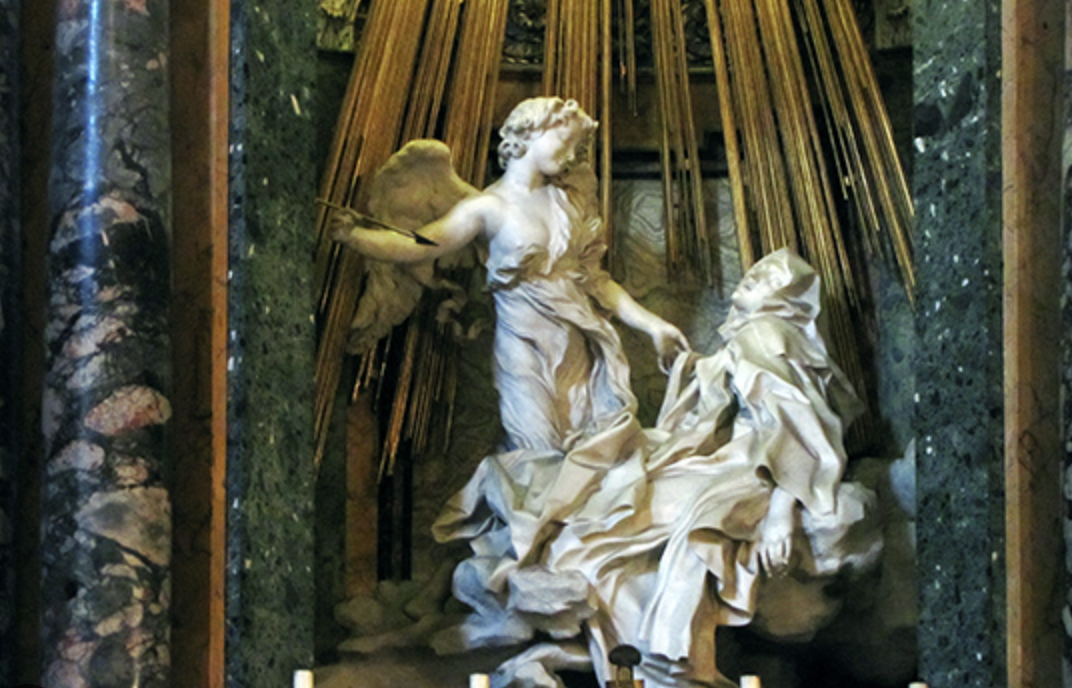
Ecstasy of St Teresa by Gianlorenzo Bernini
Gian Lorenzo Bernini, The Ecstasy of Saint Teresa, 1647-1652, white Carrara marble with gilt bronze rays, Cornaro Chapel, Santa Maria della Vittoria, Rome

Overview

About This Work

The Ecstasy of Saint Teresa (1647–1652) is Bernini's supreme masterpiece and the defining monument of High Roman Baroque religious art. Completed for Cardinal Federico Cornaro in the left transept of Santa Maria della Vittoria, the entire ensemble integrates architecture, sculpture, painting, and light into a unified bel composto (beautiful whole). The work depicts the transverberation—the mystical vision described by Teresa of Ávila in her autobiography El Libro de la Vida: an angel appearing to pierce her heart with a golden flaming spear, leaving her simultaneously in exquisite pain and overwhelming divine love. The commission coincided with Bernini's brief exclusion from papal patronage under Innocent X, paradoxically liberating him to create what many regard as his greatest achievement.

Visual Analysis

Composition

The Aedicule and Elevation: The marble figures occupy an elevated niche bordered by columns of blue marble, architecturally isolating the supernatural event from the viewer's spatial reality. The sculpture group appears to float on a thick marble cloud rendered with such delicate undercutting that stone achieves ethereal weightlessness. This vertical elevation accomplishes a sophisticated theological gesture: the vision is simultaneously present and transcendent, happening before the viewer yet existing in a separate ontological realm. The S-Curve and Gravitational Dissolution: Teresa's body forms a pronounced, unstable S-curve with her head thrown dramatically backward, eyes half-closed in rapture. Most critically, the figure lacks a clear centre of gravity—the viewer cannot locate a stable anchor point from which the body hangs. This compositional strategy enacts what ecstasy literally denotes: Greek ekstasis, "standing outside oneself." Bernini translates the mystical concept into formal language: the body, suspended and dissolved into drapery, has externalized itself from stable material existence. The angel hovers above with a serene smile, holding the delicate golden spear, not capturing the moment of piercing but rather its aftermath—Teresa now "beyond herself," burning in the ecstatic consequences.

Colour & Light

The Theatrical Window: Behind the aedicule's pediment, hidden from direct view, a window admits natural light that is then refracted and directed downward through a sculptural system of gilt bronze rays arranged in triangular formation (symbolizing the Trinity). This directional light creates the impression of heavenly radiance descending upon the figures. Critically, this illumination is not static but perpetually changing as the sun moves; Bernini employs light itself as a temporal component, making the vision's transience palpable. The Polychromatic Envelope: The chapel is clad in seventeen types of coloured marble—warm breccias in reds and yellows—creating an iridescent surround for the white sculptural group. The ceiling's painted stucco clouds deliberately overflow beyond the architectural framing, visually suggesting the heavens have "broken open" above the scene. As Wittkower observed, the light "seems fleeting, transient, impermanent," supporting the beholder's sensation of the vision's transience.

Materials & Technique

The Marble Carving Revolution: The angel and Teresa are carved from a single block of Carrara marble—a technical feat of extraordinary difficulty. The folds do not cascade in ordered channels but instead writhe and billow, creating deep shadow recesses through subtle undercutting. Flesh tones transition imperceptibly through stone sfumato, while drapery retains tactile texture. This apparent "failure" to remain classical stone is actually Bernini's theological triumph: by rendering marble as fluid, weightless, and quasi-immaterial, he transforms the sculpture into a meditation on the boundary between matter and spirit. The Hidden Light: The most technically audacious element is the hidden window's light system—a revolutionary use of light as theological instrument, with gilt bronze rays creating the physical frame through which divine grace appears to enter the material world.

Historical Context

Context

Gian Lorenzo Bernini (1598–1680) was the preeminent sculptor and architect of the Roman Baroque. Cardinal Federico Cornaro (1579–1653), a Venetian nobleman, obtained the chapel concession and commissioned this ensemble as his family burial chapel. The work emerged from the Counter-Reformation's mandate (Council of Trent, 1545–1563) that religious art be "clear, realistic, and emotionally stimulating" to inspire devotion. Saint Teresa of Ávila (1515–1582), the Spanish Carmelite reformer, described the transverberation in explicit terms: "He appeared to me to be thrusting it at times into my heart, and to pierce my very entrails; when he drew it out, he seemed to draw them out also, and to leave me all on fire with a great love of God." Bernini follows Teresa's description with extraordinary fidelity while extending it—the pain-pleasure paradox becomes the work's central theological and psychological reality.

Key Themes

The Paradox of Divine Union and the Bel Composto

Central to Teresa's mystical experience is an irreducible paradox: the transverberation is simultaneously agony and bliss, violence and tenderness, death and transformation. Bernini captures this through formal ambiguity—the angel, despite delicate beauty and serene smile, has just withdrawn a weapon from Teresa's heart. The sculpture's voluptuous forms and convulsive abandon employ explicitly erotic language, reflecting Teresa's nuptial mysticism wherein the soul as bride experiences union with God through passionate, embodied desire. The dissolution of self (Greek ekstasis, "standing outside oneself") is enacted through compositional instability: Teresa's body lacks a clear gravitational centre, fragmentized and dematerialized from Renaissance ideals. The chapel's revolutionary theatrical arrangement—with Cornaro family witnesses in illusionistic relief boxes observing the central vision—creates multiple "degrees of reality" where the threshold between viewer and represented space is deliberately blurred, enacting the theological claim that divine and human worlds are present in the same space but not on the same plane.

Exam Focus Points

Critical Perspectives

The Sensuality Controversy: From the chapel's inauguration in 1652, critics debated the apparent eroticism of Bernini's representation. Yet twentieth-century scholarship recognizes this is the work's conceptual centre. Irving Lavin wrote: "Whether or not Teresa was hysterical or Bernini vulgar, the group evinces a physical eroticism that well-meaning apologists do wrong to deny." The key interpretive move recognizes that Bernini integrates the erotic dimension into coherent theological vision rather than apologizing for it. Wittkower's "Degrees of Reality": Rudolf Wittkower identified the chapel's sophisticated intellectual achievement in creating layered reality levels. The Cornaro family portraits exist in a spatial register close to the viewer; the Teresa and angel group exists in elevated, divine register; the painted ceiling in a third register. This sophisticated stratification enacts the theological claim that mystical experience occupies a boundary between ordinary perception and divine encounter. The Material-Spiritual Transformation: By transforming stone into apparent flesh and fire, betraying classical marble's essential nature, Bernini makes visible the theological claim that matter itself can be transformed through divine encounter. The architecture, sculpture, painting, light, and bronze rays together constitute the bel composto—the beautiful unified composition in which every element, regardless of medium, contributes to unified expressive purpose.

On this page

OverviewVisual AnalysisHistorical ContextKey ThemesExam Focus Points